Ch. 7 - Structure and Synthesis of Alkenes; Elimination
Wade - Organic Chemistry 9th Edition
Wade9th EditionOrganic ChemistryISBN: 9780135213728Not the one you use?Change textbook
Chapter 7, Problem 54a

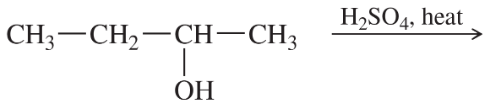
Write a balanced equation for each reaction, showing the major product you expect.
(a)

Verified step by step guidance
1
Step 1: Recognize the type of reaction. The presence of H2SO4 (sulfuric acid) and heat suggests an elimination reaction, specifically dehydration of the alcohol to form an alkene.
Step 2: Identify the alcohol functional group (-OH) in the given molecule CH3-CH2-CH(CH3)OH. The dehydration reaction will remove the -OH group and a hydrogen atom from an adjacent carbon atom, forming a double bond.
Step 3: Determine the major product using Zaitsev's rule. Zaitsev's rule states that the more substituted alkene (the one with more alkyl groups attached to the double-bonded carbons) is usually the major product.
Step 4: Write the balanced chemical equation for the reaction. The reactant is CH3-CH2-CH(CH3)OH, and the major product will be the alkene formed after elimination. Include H2O as a byproduct of the dehydration process.
Step 5: Ensure the equation is balanced. Verify that the number of atoms of each element is the same on both sides of the equation, and confirm the major product aligns with Zaitsev's rule.

Verified video answer for a similar problem:

This video solution was recommended by our tutors as helpful for the problem above.
Video duration:
3m
Was this helpful?

Key Concepts

Here are the essential concepts you must grasp in order to answer the question correctly.

Ethanol Dehydration

Ethanol dehydration is a chemical reaction where an alcohol (like CH3-CH2-CH(CH3)OH) loses a water molecule, typically in the presence of an acid catalyst such as sulfuric acid (H2SO4). This process often leads to the formation of alkenes, as the elimination of water results in the creation of a double bond between carbon atoms.
Recommended video:
Guided course
01:23
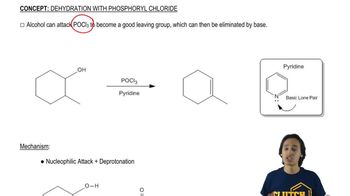
General Reaction of Dehydration with POCl3

Acid Catalysis

Acid catalysis involves the use of an acid to speed up a chemical reaction without being consumed in the process. In the context of dehydration reactions, sulfuric acid not only protonates the alcohol, making it a better leaving group, but also helps stabilize the carbocation intermediate that forms during the reaction, facilitating the elimination of water.
Recommended video:
2:50
Acid-Base Catalysis Concept 3

Balancing Chemical Equations

Balancing chemical equations is the process of ensuring that the number of atoms for each element is the same on both sides of the equation. This is crucial for accurately representing the conservation of mass in a chemical reaction. In the case of the dehydration of an alcohol, the balanced equation will reflect the reactants, products, and any byproducts formed during the reaction.
Recommended video:
3:11
Chemical Reactions of Phosphate Anhydrides Concept 1