
Textbook Question
When 2-bromo-3-phenylbutane is treated with sodium methoxide, two alkenes result (by E2 elimination). The Zaitsev product predominates.
a. Draw the reaction, showing the major and minor products.
4
views

 Verified step by step guidance
 00:40
00:40
 1:38
1:38 01:18
01:18When 2-bromo-3-phenylbutane is treated with sodium methoxide, two alkenes result (by E2 elimination). The Zaitsev product predominates.
a. Draw the reaction, showing the major and minor products.
Explain the dramatic difference in rotational energy barriers of the following three alkenes. (Hint: Consider what the transition states must look like.)
Pure (S)-2-bromo-2-fluorobutane reacts with methoxide ion in methanol to give a mixture of (S)-2-fluoro-2-methoxybutane and three fluoroalkenes.
a. Use mechanisms to show which three fluoroalkenes are formed.
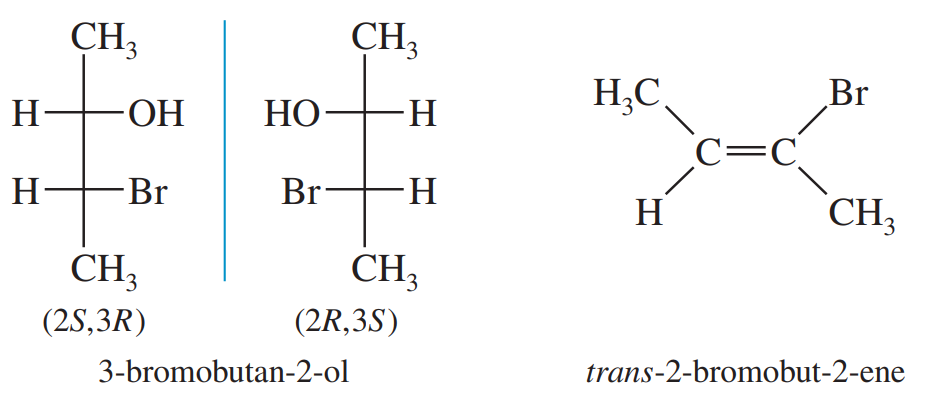
When (±)−2,3−dibromobutane reacts with potassium hydroxide, some of the products are (2S,3R)-3-bromobutan-2-ol and its enantiomer and trans-2-bromobut-2-ene. Give mechanisms to account for these products.
When 2-bromo-3-phenylbutane is treated with sodium methoxide, two alkenes result (by E2 elimination). The Zaitsev product predominates.
b. When one pure stereoisomer of 2-bromo-3-phenylbutane reacts, one pure stereoisomer of the major product results. For example, when (2R,3R)-2-bromo-3-phenylbutane reacts, the product is the stereoisomer with the methyl groups cis. Use your models to draw a Newman projection of the transition state to show why this stereospecificity is observed.
c. Use a Newman projection of the transition state to predict the major product of elimination of (2S,3R)-2-bromo-3-phenylbutane.
d. Predict the major product from elimination of (2S,3S)-2-bromo-3-phenylbutane. This prediction can be made without drawing any structures, by considering the results in part (b).
Pure (S)-2-bromo-2-fluorobutane reacts with methoxide ion in methanol to give a mixture of (S)-2-fluoro-2-methoxybutane and three fluoroalkenes.
b. Propose a mechanism to show how (S)-2-bromo-2-fluorobutane reacts to give (S)-2-fluoro-2-methoxybutane. Has this reaction gone with retention or inversion of configuration?