Ch. 7 - Structure and Synthesis of Alkenes; Elimination
Wade - Organic Chemistry 9th Edition
Wade9th EditionOrganic ChemistryISBN: 9780135213728Not the one you use?Change textbook
Chapter 7, Problem 23

Under second-order conditions (strong base/nucleophile), SN2 and E2 reactions may occur simultaneously and compete with each other. Show what products might be expected from the reaction of 2-bromo-3-methylbutane (a moderately hindered 2° alkyl halide) with sodium ethoxide.

Verified step by step guidance
1
Step 1: Identify the reaction conditions. The problem specifies second-order conditions with a strong base/nucleophile (sodium ethoxide, NaOCH₂CH₃). This indicates that both SN2 and E2 mechanisms are possible.
Step 2: Analyze the substrate. 2-bromo-3-methylbutane is a secondary (2°) alkyl halide, which is moderately hindered. This makes it suitable for both SN2 and E2 reactions, but steric hindrance may slightly favor E2 over SN2.
Step 3: Predict the SN2 product. In an SN2 reaction, the nucleophile (ethoxide ion, CH₃CH₂O⁻) will attack the carbon bonded to the bromine atom, displacing the bromine as the leaving group. The product will be an ether: 3-methyl-2-butoxyethane.
Step 4: Predict the E2 products. In an E2 reaction, the ethoxide base will abstract a β-hydrogen (a hydrogen on a carbon adjacent to the carbon bonded to the bromine). Following Zaitsev's rule, the most substituted alkene will be the major product. The major product is 2-methyl-2-butene, and the minor product is 3-methyl-1-butene.
Step 5: Summarize the competition. Both SN2 and E2 products are possible, but due to steric hindrance and the strong base/nucleophile, E2 is likely to dominate. The major E2 product is 2-methyl-2-butene, while the minor E2 product is 3-methyl-1-butene. The SN2 product (3-methyl-2-butoxyethane) may form in smaller amounts.

Verified video answer for a similar problem:

This video solution was recommended by our tutors as helpful for the problem above.
Video duration:
4m
Was this helpful?

Key Concepts

Here are the essential concepts you must grasp in order to answer the question correctly.

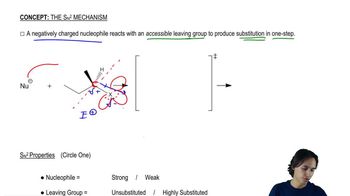
SN2 Mechanism

The SN2 mechanism is a type of nucleophilic substitution reaction where a nucleophile attacks an electrophile, resulting in the simultaneous displacement of a leaving group. This reaction occurs in a single concerted step, leading to an inversion of configuration at the carbon center. It is favored by primary and some secondary alkyl halides, especially in polar aprotic solvents, and is characterized by its dependence on steric accessibility.
Recommended video:
Guided course
08:33
Drawing the SN2 Mechanism

E2 Mechanism

The E2 mechanism is a bimolecular elimination reaction where a strong base abstracts a proton from a β-carbon while a leaving group departs from the α-carbon, resulting in the formation of a double bond. This reaction occurs in a single concerted step and typically favors the formation of the more substituted alkene, in accordance with Zaitsev's rule. The reaction rate depends on both the base and the substrate structure, making it sensitive to steric hindrance.
Recommended video:
Guided course
09:36
Drawing the E2 Mechanism.

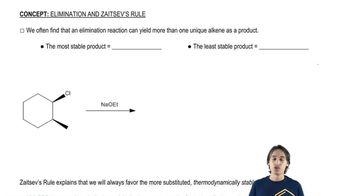
Zaitsev's Rule

Zaitsev's rule states that in elimination reactions, the more substituted alkene product is favored over less substituted ones. This is due to the greater stability of more substituted alkenes, which can be attributed to hyperconjugation and the inductive effect. However, bulky bases or leaving groups can lead to exceptions, favoring the formation of less substituted alkenes, known as Hofmann products, due to steric hindrance during the elimination process.
Recommended video:
Guided course
01:18
Defining Zaitsev’s Rule