Ch. 7 - Structure and Synthesis of Alkenes; Elimination
Wade - Organic Chemistry 9th Edition
Wade9th EditionOrganic ChemistryISBN: 9780135213728Not the one you use?Change textbook
Chapter 7, Problem 7a,b

The following names are all incorrect. Draw the structure represented by the incorrect name (or a consistent structure if the name is ambiguous), and give your drawing the correct name.
a. cis-dimethylpent-2-ene
b. 3-vinylhex-4-ene

Verified step by step guidance
1
Step 1: Analyze the name 'cis-dimethylpent-2-ene'. The prefix 'cis' indicates that the two methyl groups should be on the same side of the double bond. The root 'pent' suggests a five-carbon chain, and '2-ene' indicates a double bond between the second and third carbon atoms.
Step 2: Draw the structure for 'cis-dimethylpent-2-ene'. Start with a five-carbon chain. Place a double bond between the second and third carbons. Add methyl groups to the second and third carbons on the same side of the double bond to satisfy the 'cis' configuration.
Step 3: Identify the correct IUPAC name for the structure drawn in Step 2. Ensure that the longest carbon chain containing the double bond is identified, and number the chain to give the double bond the lowest possible number. Check the position of substituents and their configuration.
Step 4: Analyze the name '3-vinylhex-4-ene'. The root 'hex' suggests a six-carbon chain, and '4-ene' indicates a double bond between the fourth and fifth carbon atoms. The prefix '3-vinyl' suggests a vinyl group (CH2=CH-) attached to the third carbon.
Step 5: Draw the structure for '3-vinylhex-4-ene'. Start with a six-carbon chain. Place a double bond between the fourth and fifth carbons. Attach a vinyl group to the third carbon. Identify the correct IUPAC name by ensuring the longest carbon chain containing the double bond is numbered correctly, and check the position of substituents.

Verified video answer for a similar problem:

This video solution was recommended by our tutors as helpful for the problem above.
Video duration:
8m
Was this helpful?

Key Concepts

Here are the essential concepts you must grasp in order to answer the question correctly.

IUPAC Nomenclature

IUPAC nomenclature is a standardized system for naming chemical compounds. It ensures that each compound has a unique and universally accepted name. Understanding the rules of IUPAC naming, such as identifying the longest carbon chain, numbering the chain to give substituents the lowest possible numbers, and correctly identifying functional groups, is crucial for naming and interpreting organic compounds.
Recommended video:
Guided course
03:43
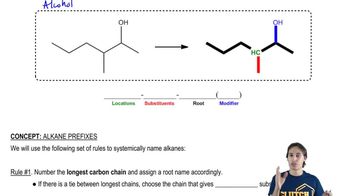
The different parts of an IUPAC name

Cis-Trans Isomerism

Cis-trans isomerism, also known as geometric isomerism, occurs in alkenes due to restricted rotation around the double bond. In 'cis' isomers, similar groups are on the same side of the double bond, while in 'trans' isomers, they are on opposite sides. Recognizing and correctly naming these isomers is essential for understanding their distinct physical and chemical properties.
Recommended video:
Guided course
00:44
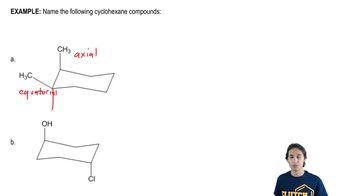
Is the following cyclohexane cis or trans?

Alkene Structure and Substitution

Alkenes are hydrocarbons with at least one carbon-carbon double bond, which affects their reactivity and structure. The position of the double bond and the nature of substituents attached to the carbon chain influence the compound's name and properties. Identifying the correct position of the double bond and any substituents is key to drawing and naming alkenes accurately.
Recommended video:
2:09
Alkene Metathesis Concept 1