Ch. 7 - Structure and Synthesis of Alkenes; Elimination
Wade - Organic Chemistry 9th Edition
Wade9th EditionOrganic ChemistryISBN: 9780135213728Not the one you use?Change textbook
Chapter 7, Problem 27d

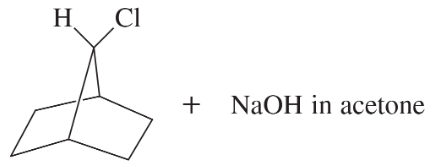
Make models of the following compounds, and predict the products formed when they react with the strong bases shown.
(d)

Verified step by step guidance
1
Step 1: Identify the type of reaction. The presence of NaOH in acetone suggests that this is an E2 elimination reaction, which typically occurs with strong bases and favors anti-coplanar geometry.
Step 2: Analyze the structure of the substrate. The molecule is a bicyclic compound with a chlorine atom attached to a carbon. The hydrogen atom on the adjacent carbon is positioned anti-coplanar to the chlorine atom, which is a requirement for E2 elimination.
Step 3: Determine the leaving group and the proton to be abstracted. In this case, the chlorine atom is the leaving group, and the base (NaOH) will abstract the anti-coplanar hydrogen from the adjacent carbon.
Step 4: Predict the product of the elimination. The removal of the hydrogen and chlorine will result in the formation of a double bond between the two carbons involved in the elimination. The bicyclic structure will remain intact, but a new alkene will be formed.
Step 5: Consider stereochemistry and regioselectivity. Since anti-coplanar geometry is required, the elimination will occur in a specific direction dictated by the spatial arrangement of the substituents. Ensure the double bond is placed correctly in the bicyclic structure.

Verified video answer for a similar problem:

This video solution was recommended by our tutors as helpful for the problem above.
Video duration:
5m
Was this helpful?

Key Concepts

Here are the essential concepts you must grasp in order to answer the question correctly.

E2 Elimination Mechanism

The E2 elimination mechanism is a concerted reaction where a strong base abstracts a proton from a β-carbon while a leaving group departs from the α-carbon, resulting in the formation of a double bond. This mechanism requires the hydrogen and leaving group to be anti-coplanar, meaning they must be on opposite sides of the molecule, which facilitates the elimination process.
Recommended video:
Guided course
09:36
Drawing the E2 Mechanism.

Anti-Coplanar vs. Syn-Coplanar

In E2 reactions, anti-coplanar arrangements are preferred because they allow for optimal orbital overlap during the transition state, leading to more stable products. Syn-coplanar arrangements, where the hydrogen and leaving group are on the same side, are less common and typically occur when free rotation around the bond is restricted, such as in cyclic compounds.
Recommended video:
Guided course
03:19
The Anti-Coplanar Requirement

Role of Strong Bases

Strong bases, like NaOH, are crucial in E2 reactions as they effectively deprotonate the β-hydrogen, facilitating the elimination of the leaving group. The choice of solvent, such as acetone, can also influence the reaction pathway and product distribution, as polar aprotic solvents can stabilize the transition state and enhance the reactivity of the base.
Recommended video:
Guided course
03:10
Monosaccharides - Strong Oxidation (Aldaric Acid)