Ch. 7 - Structure and Synthesis of Alkenes; Elimination
Wade - Organic Chemistry 9th Edition
Wade9th EditionOrganic ChemistryISBN: 9780135213728Not the one you use?Change textbook
Chapter 7, Problem 31a

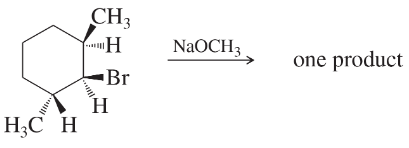
Give the expected product(s) of E2 elimination for each reaction. (Hint: Use models!)
(a)

Verified step by step guidance
1
Step 1: Identify the substrate and the leaving group. In this case, the substrate is a cyclohexane ring with a bromine atom (Br) as the leaving group. The reaction is an E2 elimination, which requires a strong base (NaOCH3) and an anti-periplanar geometry between the β-hydrogen and the leaving group.
Step 2: Locate the β-hydrogens on the carbon atoms adjacent to the carbon bearing the bromine atom. In this structure, there are two β-hydrogens: one on the axial position and one on the equatorial position.
Step 3: Determine the anti-periplanar relationship. For E2 elimination to occur, the β-hydrogen and the leaving group (Br) must be anti-periplanar, meaning they are on opposite sides of the plane of the ring. In this case, the axial β-hydrogen is anti-periplanar to the bromine atom.
Step 4: Remove the bromine atom and the anti-periplanar β-hydrogen. This elimination results in the formation of a double bond between the two carbons involved in the elimination process.
Step 5: Draw the product. The double bond will form in the ring, resulting in a cyclohexene structure. Ensure the stereochemistry of the remaining substituents is preserved in the product.

Verified video answer for a similar problem:

This video solution was recommended by our tutors as helpful for the problem above.
Video duration:
2m
Was this helpful?

Key Concepts

Here are the essential concepts you must grasp in order to answer the question correctly.

E2 Elimination Mechanism

The E2 elimination mechanism is a concerted reaction where a base removes a proton from a β-carbon while a leaving group departs from the α-carbon, resulting in the formation of a double bond. This mechanism requires the base to be strong and the substrate to have a suitable leaving group. The stereochemistry of the reaction is crucial, as it typically favors anti-periplanar geometry for optimal overlap of orbitals.
Recommended video:
Guided course
09:36
Drawing the E2 Mechanism.

Stereochemistry in E2 Reactions

Stereochemistry plays a significant role in E2 reactions, as the elimination must occur from an anti-periplanar arrangement. This means that the hydrogen atom being removed and the leaving group must be positioned opposite each other in a staggered conformation. Understanding the spatial arrangement of substituents on the cyclohexane ring is essential for predicting the correct product of the elimination reaction.
Recommended video:
1:38
Polymer Stereochemistry Concept 1

Cyclohexane Conformation

Cyclohexane can adopt various conformations, with the chair conformation being the most stable. In this conformation, substituents can occupy axial or equatorial positions, influencing the reactivity in elimination reactions. Recognizing the preferred positions of the bromine and hydrogen atoms in the chair form is vital for determining which hydrogen will be eliminated during the E2 reaction with NaOCH3.
Recommended video:
Guided course
03:29
Understanding what a conformer is.