
Ch.5 - Stereochemistry
Wade - Organic Chemistry 9th Edition
Wade9th EditionOrganic ChemistryISBN: 9780135213728Not the one you use?Change textbook
Chapter 5, Problem 24

To show that (R)-2-butyl (R,R)-tartrate and (S)-2-butyl (R,R)-tartrate are not enantiomers, draw and name the mirror images of these compounds.

Verified step by step guidance
1
Understand the problem: The task is to determine whether (R)-2-butyl (R,R)-tartrate and (S)-2-butyl (R,R)-tartrate are enantiomers. Enantiomers are non-superimposable mirror images of each other. To do this, we need to draw the mirror images of both compounds and analyze their stereochemistry.
Step 1: Draw the structure of (R)-2-butyl (R,R)-tartrate. Start by drawing the tartrate backbone, which contains two chiral centers with the (R,R) configuration. Attach the (R)-2-butyl group to the appropriate position on the tartrate molecule.
Step 2: Draw the mirror image of (R)-2-butyl (R,R)-tartrate. Reflect the entire molecule across a vertical mirror plane. Ensure that the stereochemistry of the chiral centers is inverted in the mirror image.
Step 3: Repeat the process for (S)-2-butyl (R,R)-tartrate. Draw the structure of (S)-2-butyl (R,R)-tartrate by attaching the (S)-2-butyl group to the tartrate backbone. Then, draw its mirror image by reflecting the molecule across a vertical mirror plane.
Step 4: Compare the mirror images of (R)-2-butyl (R,R)-tartrate and (S)-2-butyl (R,R)-tartrate. Check if the mirror images of these compounds are superimposable. If they are not superimposable, the compounds are not enantiomers. Analyze the stereochemistry of the chiral centers to confirm this conclusion.

Verified video answer for a similar problem:

This video solution was recommended by our tutors as helpful for the problem above.
Video duration:
8m
Was this helpful?

Key Concepts

Here are the essential concepts you must grasp in order to answer the question correctly.

Enantiomers

Enantiomers are a pair of molecules that are non-superimposable mirror images of each other. They have the same molecular formula and connectivity but differ in the spatial arrangement of atoms. This concept is crucial in stereochemistry, as enantiomers often exhibit different optical activities and can have distinct biological effects.
Recommended video:
Guided course
03:23
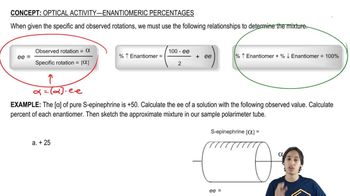
How to solve for the percentage of each enantiomer.

Chirality

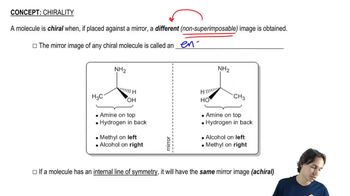
Chirality refers to the property of a molecule that makes it non-superimposable on its mirror image. A chiral molecule typically has at least one carbon atom bonded to four different substituents, creating two distinct configurations. Understanding chirality is essential for identifying enantiomers and determining their relationships.
Recommended video:
Guided course
05:10
What is chirality?

Stereocenters

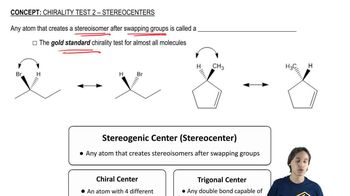
Stereocenters, or chiral centers, are atoms in a molecule that have four different substituents attached, leading to the possibility of stereoisomerism. In the context of the question, identifying the stereocenters in (R)-2-butyl and (S)-2-butyl tartrate is key to drawing their mirror images and determining whether they are enantiomers or not.
Recommended video:
Guided course
02:15
What is a stereocenter?