
Ch.5 - Stereochemistry
Wade - Organic Chemistry 9th Edition
Wade9th EditionOrganic ChemistryISBN: 9780135213728Not the one you use?Change textbook
Chapter 5, Problem 41a

The original definition of meso is 'an achiral compound that has chiral diastereomers.' Our working definition of meso is 'an achiral compound that has chiral centers (usually asymmetric carbon atoms).' The working definition is much easier to apply, because we don't have to envision all possible chiral diastereomers of the compound. Still, the working definition is not quite as complete as the original definition.
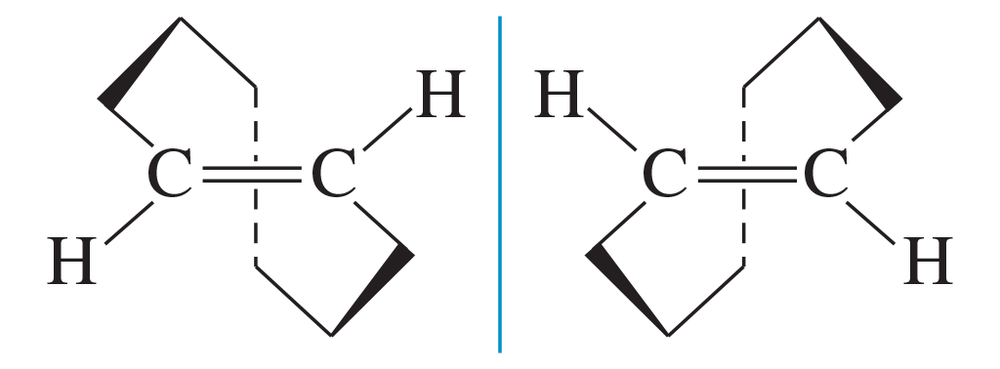
a. Show how cis-cyclooctene is defined as a meso compound under the original definition, but not under our working definition. (Review Figure 5-19)

Verified step by step guidance
1
Step 1: Begin by understanding the original definition of a meso compound: 'an achiral compound that has chiral diastereomers.' This means the compound itself is achiral (it has a plane of symmetry or is superimposable on its mirror image), but it can have diastereomers that are chiral.
Step 2: Analyze cis-cyclooctene under the original definition. Cis-cyclooctene is achiral because it has a plane of symmetry. The molecule is symmetrical across the double bond, making it superimposable on its mirror image. However, if you envision possible diastereomers (e.g., trans-cyclooctene), these diastereomers are chiral due to the lack of symmetry in the trans configuration.
Step 3: Now consider the working definition of a meso compound: 'an achiral compound that has chiral centers (usually asymmetric carbon atoms).' Cis-cyclooctene does not have any chiral centers (asymmetric carbon atoms). The carbons involved in the double bond are sp2 hybridized and do not meet the criteria for chirality. Therefore, cis-cyclooctene does not qualify as meso under this definition.
Step 4: Refer to Figure 5-19 for visual clarification. The figure shows cis-cyclooctene and its mirror image, which are superimposable due to the plane of symmetry. This confirms its achirality. The figure also highlights the absence of chiral centers in the molecule, supporting the conclusion that it does not meet the working definition of meso.
Step 5: Conclude that cis-cyclooctene is defined as meso under the original definition because it is achiral and has chiral diastereomers (e.g., trans-cyclooctene). However, it does not meet the working definition of meso because it lacks chiral centers.

Verified video answer for a similar problem:

This video solution was recommended by our tutors as helpful for the problem above.
Video duration:
4m
Was this helpful?

Key Concepts

Here are the essential concepts you must grasp in order to answer the question correctly.

Meso Compounds

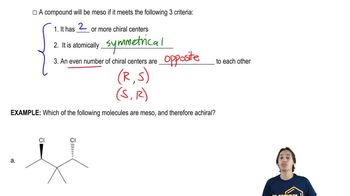
Meso compounds are defined as achiral molecules that contain multiple chiral centers but possess an internal plane of symmetry. This symmetry allows the molecule to be superimposable on its mirror image, thus rendering it achiral despite having chiral centers. Understanding this concept is crucial for identifying compounds like cis-cyclooctene, which can exhibit meso characteristics under certain conditions.
Recommended video:
Guided course
04:10
The 3 rules of meso compounds.

Chirality and Chiral Centers

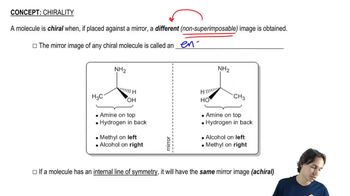
Chirality refers to the geometric property of a molecule that makes it non-superimposable on its mirror image, typically due to the presence of chiral centers, which are usually carbon atoms bonded to four different substituents. In the context of meso compounds, recognizing chiral centers is essential, as these centers contribute to the overall stereochemistry of the molecule, influencing whether it can be classified as meso or not.
Recommended video:
Guided course
05:10
What is chirality?

Cis-Trans Isomerism

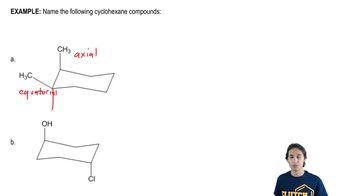
Cis-trans isomerism is a form of stereoisomerism where the spatial arrangement of substituents around a double bond or ring structure differs. In the case of cis-cyclooctene, the arrangement of hydrogen atoms and the double bond leads to distinct geometric configurations. This isomerism plays a significant role in determining the compound's chirality and whether it meets the criteria for being classified as a meso compound.
Recommended video:
Guided course
00:44
Is the following cyclohexane cis or trans?
Related Practice
Textbook Question

3,4-Dimethylpent-1-ene has the formula CH2=CH—CH(CH3)—CH(CH3)2. When pure (R)-3,4-dimethylpent-1-ene is treated with hydrogen over a platinum catalyst, the product is (S)-2,3-dimethylpentane.

d. How useful is the (R) or (S) designation for predicting the sign of an optical rotation? Can you predict the sign of the rotation of the reactant? Of the product? (Hint from Juliet Capulet: “What’s in a name? That which we call a rose/By any other name would smell as sweet.”)

2
views
Textbook Question

A graduate student was studying enzymatic reductions of cyclohexanones when she encountered some interesting chemistry. When she used an enzyme and NADPH to reduce the following ketone, she was surprised to find that the product was optically active. She carefully repurified the product so that no enzyme, NADPH, or other contaminants were present. Still, the product was optically active.

c. If this reaction could be accomplished using H2 and a nickel catalyst, would the product be optically active? Explain.

1
views
Textbook Question

3,4-Dimethylpent-1-ene has the formula CH2=CH—CH(CH3)—CH(CH3)2. When pure (R)-3,4-dimethylpent-1-ene is treated with hydrogen over a platinum catalyst, the product is (S)-2,3-dimethylpentane.

c. The reactant is named (R), but the product is named (S). Does this name change imply a change in the spatial arrangement of the groups around the chiral center? So why does the name switch from (R) to (S)?

1
views
Textbook Question

Draw a three-dimensional structure for each compound, and star all asymmetric carbon atoms. Draw the mirror for each structure, and state whether you have drawn a pair of enantiomers or just the same molecule twice. Build molecular models of any of these examples that seem difficult to you.

(e) chlorocyclohexane

(f) cis-1,2-dichlorocyclobutane

1
views