

Ch.5 - Stereochemistry
Wade - Organic Chemistry 9th Edition
Wade9th EditionOrganic ChemistryISBN: 9780135213728Not the one you use?Change textbook
Chapter 5, Problem 16c

For each set of examples, make a model of the first structure, and indicate the relationship of each of the other structures to the first structure. Examples of relationships: same compound, enantiomer, structural isomer.
(c)

Verified step by step guidance
1
Step 1: Begin by analyzing the first structure, which is labeled as (R)-butan-2-ol. This structure has a chiral center at the second carbon atom, with the following substituents: a hydroxyl group (-OH), a methyl group (-CH3), an ethyl group (-CH2CH3), and a hydrogen atom (H). The (R) configuration indicates the absolute stereochemistry based on the Cahn-Ingold-Prelog priority rules.
Step 2: Compare the second structure to the first structure. Notice that the positions of the substituents around the chiral center are inverted. This inversion of substituents indicates that the second structure is the enantiomer of the first structure, specifically the (S)-butan-2-ol.
Step 3: Compare the third structure to the first structure. Observe that the hydroxyl group (-OH) and the hydrogen atom (H) have swapped positions, but the methyl group (-CH3) and ethyl group (-CH2CH3) remain in the same positions. This inversion of two substituents around the chiral center also results in the enantiomer of the first structure, which is again (S)-butan-2-ol.
Step 4: Compare the fourth structure to the first structure. Notice that the arrangement of substituents around the chiral center is identical to the first structure. This indicates that the fourth structure is the same compound as the first structure, (R)-butan-2-ol.
Step 5: Summarize the relationships: The second and third structures are enantiomers of the first structure, while the fourth structure is the same compound as the first structure.

Verified video answer for a similar problem:

This video solution was recommended by our tutors as helpful for the problem above.
Video duration:
4m
Was this helpful?

Key Concepts

Here are the essential concepts you must grasp in order to answer the question correctly.

Stereoisomerism

Stereoisomerism refers to the phenomenon where compounds have the same molecular formula and connectivity of atoms but differ in the spatial arrangement of their atoms. This includes enantiomers, which are non-superimposable mirror images of each other, and diastereomers, which are not mirror images. Understanding stereoisomerism is crucial for analyzing the relationships between different structures, such as those shown in the provided image.
Recommended video:
Guided course
01:58
Determining when molecules are stereoisomers.

Structural Isomers

Structural isomers are compounds that have the same molecular formula but differ in the connectivity of their atoms. This can lead to different functional groups or arrangements, resulting in distinct chemical properties. In the context of the question, recognizing structural isomers is essential for identifying how the given structures relate to (R)-butan-2-ol, as they may share the same formula but differ in structure.
Recommended video:
Guided course
01:10
What is a constitutional isomer?

Chirality

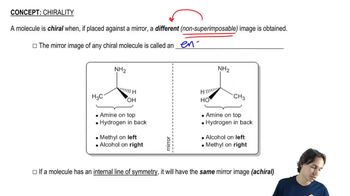
Chirality is a property of a molecule that makes it non-superimposable on its mirror image, much like left and right hands. A chiral center, often a carbon atom bonded to four different groups, is responsible for this property. In the case of (R)-butan-2-ol, its chirality leads to the existence of enantiomers, which are critical for understanding the relationships depicted in the image, as they can exhibit different optical activities.
Recommended video:
Guided course
05:10
What is chirality?
Related Practice
Textbook Question

Draw a Fischer projection for each compound. Remember that the cross represents an asymmetric carbon atom, and the carbon chain should be along the vertical, with the IUPAC numbering from top to bottom.

(c) (S)-1,2-dibromobutane

(d) (R)-butan-2-ol

1
views
Textbook Question

For each set of examples, make a model of the first structure, and indicate the relationship of each of the other structures to the first structure. Examples of relationships: same compound, enantiomer, structural isomer.

(a)

1
views
Textbook Question

Draw a Fischer projection for each compound. Remember that the cross represents an asymmetric carbon atom, and the carbon chain should be along the vertical, with the IUPAC numbering from top to bottom.

(e)

1
views
Textbook Question

Draw three-dimensional representations of the following compounds. Which have asymmetric carbon atoms? Which have no asymmetric carbons but are chiral anyway? Use your models for parts (a) through (d) and any others that seem unclear.

(e)

(f)

2
views
Textbook Question

Draw a Fischer projection for each compound. Remember that the cross represents an asymmetric carbon atom, and the carbon chain should be along the vertical, with the IUPAC numbering from top to bottom.

(a) (S)-propane-1,2-diol

(b) (R)-2-bromobutan-1-ol

2
views
Textbook Question

Draw three-dimensional representations of the following compounds. Which have asymmetric carbon atoms? Which have no asymmetric carbons but are chiral anyway? Use your models for parts (a) through (d) and any others that seem unclear.

(g)

1
views