
Ch.5 - Stereochemistry
Wade - Organic Chemistry 9th Edition
Wade9th EditionOrganic ChemistryISBN: 9780135213728Not the one you use?Change textbook
Chapter 5, Problem 27a,b

For each of the compounds described by the following names,
1. draw a three-dimensional representation.
2. star (*) each chiral center.
3. draw any planes of symmetry.
4. draw any enantiomer.
5. draw any diastereomers.
6. label each structure you have drawn as chiral or achiral.
a. (S)-2-chlorobutane
b. (R)-1,1,2-trimethylcyclohexane

Verified step by step guidance
1
Step 1: Begin by understanding the IUPAC names of the compounds. For (S)-2-chlorobutane, the 'S' configuration indicates the stereochemistry of the chiral center. For (R)-1,1,2-trimethylcyclohexane, the 'R' configuration specifies the stereochemistry of the chiral center. Identify the molecular structure based on the name.
Step 2: Draw the three-dimensional representation of each compound. For (S)-2-chlorobutane, place the chlorine atom and other substituents around the chiral center in a tetrahedral arrangement. For (R)-1,1,2-trimethylcyclohexane, draw the cyclohexane ring with the methyl groups positioned according to the stereochemistry.
Step 3: Identify and mark the chiral centers with a star (*). For (S)-2-chlorobutane, the chiral center is the carbon atom bonded to the chlorine, hydrogen, and two other carbon groups. For (R)-1,1,2-trimethylcyclohexane, identify the chiral center based on the stereochemistry and substituent arrangement.
Step 4: Draw any planes of symmetry for each compound. For (S)-2-chlorobutane, check if the molecule has any symmetry planes. For (R)-1,1,2-trimethylcyclohexane, analyze the cyclohexane ring and substituents to determine symmetry.
Step 5: Draw the enantiomers and diastereomers. For (S)-2-chlorobutane, the enantiomer will have the opposite stereochemistry (R). For (R)-1,1,2-trimethylcyclohexane, draw the enantiomer with reversed stereochemistry and any diastereomers by altering the configuration of one or more chiral centers. Label each structure as chiral or achiral based on the presence of chiral centers and symmetry.

Verified video answer for a similar problem:

This video solution was recommended by our tutors as helpful for the problem above.
Video duration:
5m
Was this helpful?

Key Concepts

Here are the essential concepts you must grasp in order to answer the question correctly.

Chirality

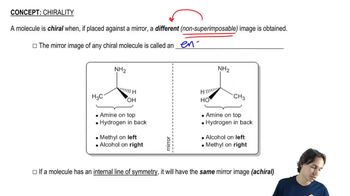
Chirality refers to the geometric property of a molecule that makes it non-superimposable on its mirror image, much like left and right hands. A chiral center, typically a carbon atom, is bonded to four different substituents, leading to two distinct enantiomers. Understanding chirality is crucial for identifying chiral centers in compounds and determining their stereochemical configurations.
Recommended video:
Guided course
05:10
What is chirality?

Stereoisomers

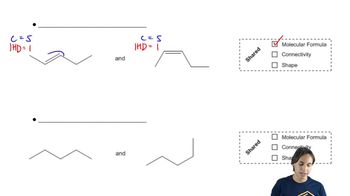
Stereoisomers are compounds that have the same molecular formula and connectivity of atoms but differ in the spatial arrangement of their atoms. This category includes enantiomers, which are non-superimposable mirror images, and diastereomers, which are not mirror images of each other. Recognizing the types of stereoisomers is essential for drawing enantiomers and diastereomers of given compounds.
Recommended video:
Guided course
01:58
Determining when molecules are stereoisomers.

Planes of Symmetry

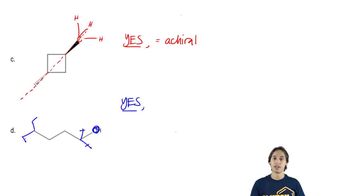
A plane of symmetry in a molecule is an imaginary plane that divides the molecule into two mirror-image halves. The presence of a plane of symmetry indicates that a molecule is achiral, while its absence suggests chirality. Identifying planes of symmetry is important for determining whether a compound is chiral or achiral, which is a key aspect of the question.
Recommended video:
Guided course
02:58
Determining Chirality with Plane of Symmetry