
Ch.5 - Stereochemistry
Wade - Organic Chemistry 9th Edition
Wade9th EditionOrganic ChemistryISBN: 9780135213728Not the one you use?Change textbook
Chapter 5, Problem 1

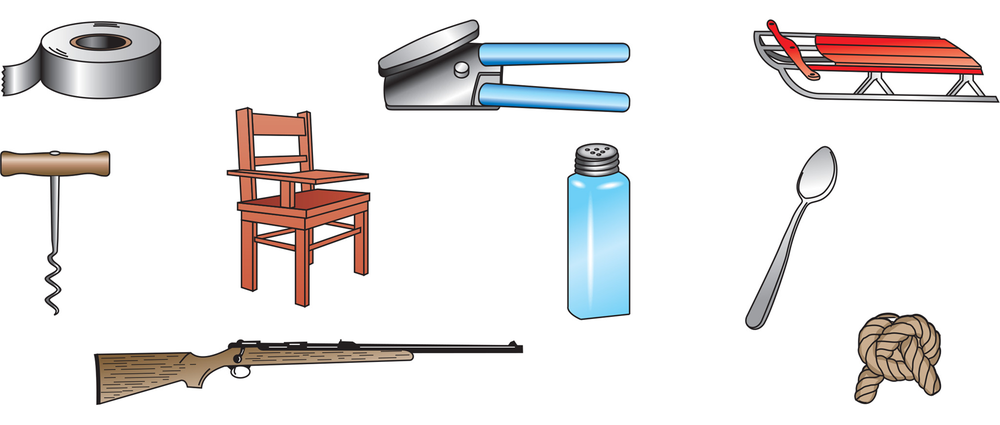
Determine whether the following objects are chiral or achiral.

Verified step by step guidance
1
Identify the key features of each object or molecule shown in the images, focusing on symmetry elements such as planes of symmetry, centers of inversion, or improper rotation axes.
Recall that a molecule or object is chiral if it lacks any internal plane of symmetry and cannot be superimposed on its mirror image; otherwise, it is achiral.
For each object, look for a plane of symmetry (mirror plane). If such a plane exists, the object is achiral because it can be reflected onto itself.
Check for the presence of a center of inversion or improper rotation axes (S_n). The presence of these symmetry elements also indicates achirality.
Conclude the chirality of each object by combining your observations: if no symmetry elements that cause superimposability with the mirror image are found, the object is chiral; if any such symmetry element exists, it is achiral.

Verified video answer for a similar problem:

This video solution was recommended by our tutors as helpful for the problem above.
Video duration:
4m
Was this helpful?

Key Concepts

Here are the essential concepts you must grasp in order to answer the question correctly.

Chirality and Achirality

Chirality refers to an object or molecule that is not superimposable on its mirror image, often due to the presence of an asymmetric carbon atom. Achiral objects are superimposable on their mirror images and usually have a plane of symmetry. Understanding this distinction is essential to classify molecules as chiral or achiral.
Recommended video:
Guided course
05:10
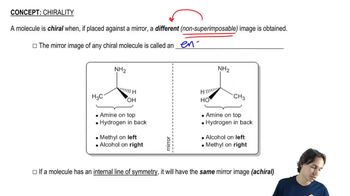
What is chirality?

Symmetry Elements in Molecules

Symmetry elements such as planes of symmetry (σ), centers of inversion (i), and rotation axes (Cn) help determine molecular chirality. The presence of a plane of symmetry or an inversion center generally indicates achirality, while their absence suggests chirality. Identifying these elements aids in analyzing molecular structures.
Recommended video:
Guided course
00:25
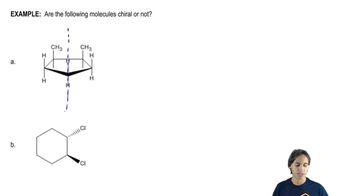
Determining Chirality with Plane of Symmetry

Stereochemistry and Molecular Models

Stereochemistry involves the spatial arrangement of atoms in molecules. Using molecular models or drawings helps visualize three-dimensional structures, making it easier to assess chirality. Recognizing how substituents are arranged around stereocenters is crucial for determining if an object is chiral or achiral.
Recommended video:
1:38
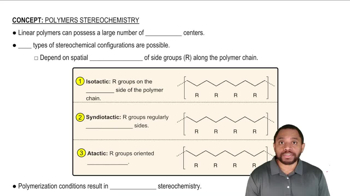
Polymer Stereochemistry Concept 1