
Textbook Question
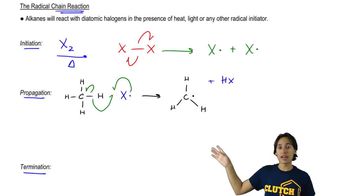
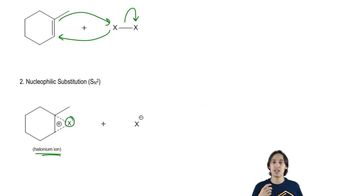
For each compound, predict the major product of free-radical bromination. Remember that bromination is highly selective, and only the most stable radical will be formed.
(e)
1
views

 Verified step by step guidance
 12:11
12:11
 03:45
03:45 1:18
1:18For each compound, predict the major product of free-radical bromination. Remember that bromination is highly selective, and only the most stable radical will be formed.
(e)
The chlorination of pentane gives a mixture of three monochlorinated products.
b. Predict the ratios in which these monochlorination products will be formed, remembering that a chlorine atom abstracts a secondary hydrogen about 4.5 times as fast as it abstracts a primary hydrogen.
The chlorination of pentane gives a mixture of three monochlorinated products.
a. Draw their structures.
When exactly 1 mole of methane is mixed with exactly 1 mole of chlorine and light is shone on the mixture, a chlorination reaction occurs. The products are found to contain substantial amounts of di-, tri-, and tetrachloromethane, as well as unreacted methane.
a. Explain how a mixture is formed from this stoichiometric mixture of reactants, and propose mechanisms for the formation of these compounds from chloromethane.
a. Draw the structure of the transition state for the second propagation step in the chlorination of methane.
Show whether the transition state is product-like or reactant-like and which of the two partial bonds is stronger.
For each compound, predict the major product of free-radical bromination. Remember that bromination is highly selective, and only the most stable radical will be formed.
(f)