Ch.4 - The Study of Chemical Reactions
Wade - Organic Chemistry 9th Edition
Wade9th EditionOrganic ChemistryISBN: 9780135213728Not the one you use?Change textbook
Chapter 4, Problem 18

What would be the product ratio in the chlorination of propane if all the hydrogens were abstracted at equal rates?

Verified step by step guidance
1
Identify the types of hydrogens in propane. Propane (C3H8) has two types of hydrogens: primary hydrogens (attached to the terminal carbons) and secondary hydrogens (attached to the central carbon).
Count the number of each type of hydrogen. Propane has 6 primary hydrogens (3 on each terminal carbon) and 2 secondary hydrogens (on the central carbon).
Assume that all hydrogens are abstracted at equal rates, meaning there is no preference for primary or secondary hydrogens during the chlorination process.
Determine the product ratio based on the number of hydrogens available for abstraction. The ratio of products will correspond to the ratio of primary to secondary hydrogens, which is 6:2 or 3:1.
Conclude that the product ratio will reflect the statistical likelihood of abstraction, resulting in a 3:1 ratio of chlorinated products derived from primary and secondary hydrogens, respectively.

Verified video answer for a similar problem:

This video solution was recommended by our tutors as helpful for the problem above.
Video duration:
3m
Was this helpful?

Key Concepts

Here are the essential concepts you must grasp in order to answer the question correctly.

Radical Halogenation

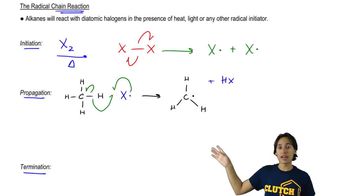
Radical halogenation is a reaction where alkanes react with halogens (like chlorine) in the presence of heat or light to form alkyl halides. This process involves the formation of free radicals, which are highly reactive species with unpaired electrons. The reaction proceeds through initiation, propagation, and termination steps, leading to the substitution of hydrogen atoms by halogen atoms.
Recommended video:
Guided course
12:11
Radical Chain Reaction Mechanism.

Product Distribution

In the chlorination of propane, the product distribution refers to the ratio of different alkyl halides formed, which depends on the stability of the resulting radicals. Propane can form primary, secondary, and tertiary radicals, with secondary radicals being more stable than primary ones. If all hydrogen atoms are abstracted at equal rates, the product ratio will reflect the relative stabilities of these radicals.
Recommended video:
Guided course
11:07
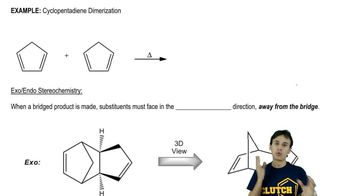
Bridged-Products

Statistical Distribution

Statistical distribution in this context refers to the likelihood of each hydrogen atom being abstracted during the chlorination process. If all hydrogens are abstracted at equal rates, the resulting product ratio can be predicted based on the number of each type of hydrogen in propane. This leads to a specific ratio of products, which can be calculated based on the number of equivalent hydrogen atoms in primary, secondary, and tertiary positions.
Recommended video:
Guided course
02:46
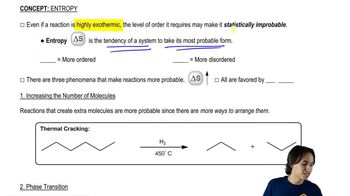
Explaining what entropy is.