
Ch.4 - The Study of Chemical Reactions
Wade - Organic Chemistry 9th Edition
Wade9th EditionOrganic ChemistryISBN: 9780135213728Not the one you use?Change textbook
Chapter 4, Problem 51

Peroxides are often added to free-radical reactions as initiators because the oxygen–oxygen bond cleaves homolytically rather easily. For example, the bond-dissociation enthalpy of the O―O bond in hydrogen peroxide (H―O―O―H) is only 213 kJ/mol (51 kcal/mol). Give a mechanism for the hydrogen peroxide-initiated reaction of cyclopentane with chlorine. The BDE for HO―Cl is 210 kJ/mol (50 kcal/mol).

Verified step by step guidance
1
Step 1: Begin by understanding the role of hydrogen peroxide (H₂O₂) as a radical initiator. The O―O bond in H₂O₂ undergoes homolytic cleavage due to its low bond dissociation enthalpy (213 kJ/mol), forming two hydroxyl radicals (•OH). This is the initiation step of the free-radical mechanism.
Step 2: In the presence of chlorine (Cl₂), the hydroxyl radical (•OH) reacts with Cl₂ to form hypochlorous acid (HOCl) and a chlorine radical (•Cl). This step is crucial for generating the reactive chlorine radical that will propagate the reaction.
Step 3: The chlorine radical (•Cl) abstracts a hydrogen atom from cyclopentane (C₅H₁₀), forming cyclopentyl radical (C₅H₉•) and HCl. This step initiates the propagation phase of the reaction, where the cyclopentyl radical becomes the reactive intermediate.
Step 4: The cyclopentyl radical (C₅H₉•) reacts with another molecule of Cl₂, forming cyclopentyl chloride (C₅H₉Cl) and regenerating a chlorine radical (•Cl). This step continues the propagation cycle, allowing the reaction to proceed further.
Step 5: Termination occurs when two radicals combine to form a stable molecule, such as two chlorine radicals (•Cl) forming Cl₂ or a chlorine radical (•Cl) combining with a cyclopentyl radical (C₅H₉•) to form cyclopentyl chloride (C₅H₉Cl). This step ends the chain reaction.

Verified video answer for a similar problem:

This video solution was recommended by our tutors as helpful for the problem above.
Video duration:
9m
Was this helpful?

Key Concepts

Here are the essential concepts you must grasp in order to answer the question correctly.

Homolytic Bond Cleavage

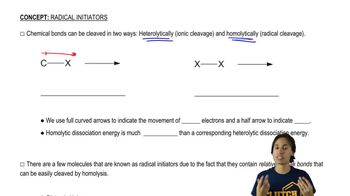
Homolytic bond cleavage refers to the process where a covalent bond breaks evenly, resulting in the formation of two radicals, each containing one of the shared electrons. This type of cleavage is crucial in free-radical reactions, as it generates reactive species that can initiate further reactions. In the context of peroxides, the relatively low bond-dissociation enthalpy of the O―O bond allows for easy homolytic cleavage, making them effective initiators.
Recommended video:
Guided course
04:39
Heterolytic vs. Homolytic Bond Cleavage .

Free-Radical Mechanism

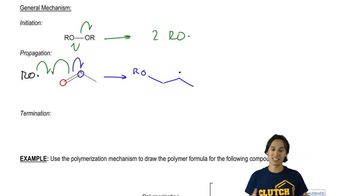
A free-radical mechanism involves a series of steps where free radicals are generated and react with other molecules. Typically, this mechanism includes initiation (formation of radicals), propagation (reaction of radicals with stable molecules), and termination (recombination of radicals). Understanding this mechanism is essential for analyzing reactions involving peroxides and halogens, such as the reaction of cyclopentane with chlorine initiated by hydrogen peroxide.
Recommended video:
Guided course
03:28
The mechanism of Radical Polymerization.

Bond-Dissociation Enthalpy (BDE)

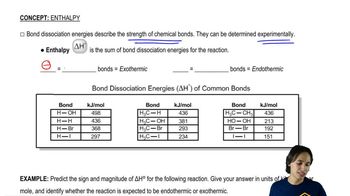
Bond-dissociation enthalpy (BDE) is the energy required to break a specific bond in a molecule homolytically. It is a critical factor in determining the stability of radicals and the feasibility of reactions. In the given example, the BDE of the O―O bond in hydrogen peroxide and the HO―Cl bond provides insight into the energy dynamics of the reaction, influencing the likelihood of radical formation and subsequent reactions.
Recommended video:
Guided course
04:09
How to calculate enthalpy using bond dissociation energies.
Related Practice
Textbook Question

The chlorination of pentane gives a mixture of three monochlorinated products.

b. Predict the ratios in which these monochlorination products will be formed, remembering that a chlorine atom abstracts a secondary hydrogen about 4.5 times as fast as it abstracts a primary hydrogen.

7
views
Textbook Question

When ethene is treated in a calorimeter with H2 and a Pt catalyst, the heat of reaction is found to be –137 kJ/mol (–32.7 kcal/mol), and the reaction goes to completion. When the reaction takes place at 1400 K, the equilibrium is found to be evenly balanced, with Keq =1.  Compute the value of ΔS for this reaction.

2
views
Textbook Question

The chlorination of pentane gives a mixture of three monochlorinated products.

a. Draw their structures.

1
views
Textbook Question

a. Draw the structure of the transition state for the second propagation step in the chlorination of methane.

Show whether the transition state is product-like or reactant-like and which of the two partial bonds is stronger.

2
views
Textbook Question

When dichloromethane is treated with strong NaOH, an intermediate is generated that reacts like a carbene. Draw the structure of this reactive intermediate, and propose a mechanism for its formation.

2
views
Textbook Question

When a small amount of iodine is added to a mixture of chlorine and methane, it prevents chlorination from occurring. Therefore, iodine is a free-radical inhibitor for this reaction. Calculate ΔH° values for the possible reactions of iodine with species present in the chlorination of methane, and use these values to explain why iodine inhibits the reaction. (The I―Cl bond-dissociation enthalpy is 211 kJ/mol or 50 kcal/mol.)

2
views