

Ch.4 - The Study of Chemical Reactions
Wade - Organic Chemistry 9th Edition
Wade9th EditionOrganic ChemistryISBN: 9780135213728Not the one you use?Change textbook
Chapter 4, Problem 57a

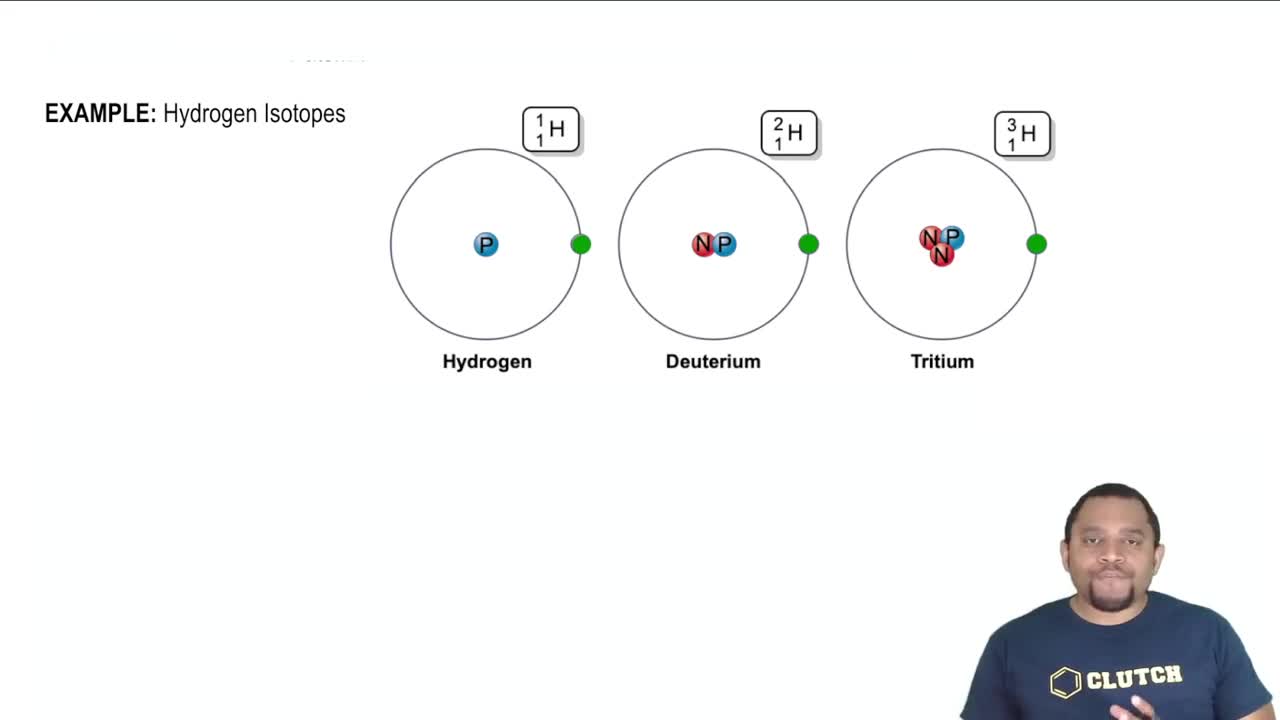
Deuterium (D) is the hydrogen isotope of mass number 2, with a proton and a neutron in its nucleus. The chemistry of deuterium is nearly identical to the chemistry of hydrogen, except that the C―D bond is slightly stronger than the C―H bond by 5.0 kJ/mol (1.2 kcal/mol). Reaction rates tend to be slower when a C―D bond (as opposed to a C―H bond) is broken in a rate-limiting step.
This effect, called a kinetic isotope effect, is clearly seen in the chlorination of methane. Methane undergoes free-radical chlorination 12 times as fast as tetradeuteriomethane (CD4).

a. Draw the transition state for the rate-limiting step of each of these reactions, showing how a bond to hydrogen or ­deuterium is being broken in this step.

Verified step by step guidance
1
Step 1: Understand the problem. The question asks us to draw the transition state for the rate-limiting step of two reactions: the chlorination of methane (CH4) and tetradeuteriomethane (CD4). The rate-limiting step involves breaking a C-H or C-D bond, and the kinetic isotope effect explains why the reaction with CH4 is faster than with CD4.
Step 2: Recall the concept of a transition state. A transition state represents the highest energy point along the reaction pathway. In this case, it involves the partial breaking of the C-H or C-D bond and the partial formation of the Cl-H or Cl-D bond. The transition state is typically represented with dashed lines to indicate bonds that are in the process of breaking or forming.
Step 3: Draw the transition state for CH4. In the reaction CH4 + Cl⋅ → CH3Cl + HCl, the transition state will show the carbon atom partially bonded to the hydrogen atom (C-H bond breaking) and the chlorine atom partially bonded to the hydrogen atom (Cl-H bond forming). Use dashed lines to represent these partial bonds.
Step 4: Draw the transition state for CD4. In the reaction CD4 + Cl⋅ → CD3Cl + DCl, the transition state will be similar to the one for CH4, but it will involve the breaking of a C-D bond and the formation of a Cl-D bond. Again, use dashed lines to represent the partial bonds.
Step 5: Highlight the difference between the two transition states. The key difference lies in the bond being broken: the C-H bond in CH4 versus the C-D bond in CD4. Since the C-D bond is stronger (by 5.0 kJ/mol), the transition state for CD4 will be higher in energy, which explains the slower reaction rate for CD4 compared to CH4.

Verified video answer for a similar problem:

This video solution was recommended by our tutors as helpful for the problem above.
Video duration:
10m
Was this helpful?

Key Concepts

Here are the essential concepts you must grasp in order to answer the question correctly.

Kinetic Isotope Effect

The kinetic isotope effect (KIE) refers to the change in reaction rate that occurs when an atom in a molecule is replaced by one of its isotopes. In organic reactions, this effect is particularly significant for hydrogen isotopes, such as deuterium, due to the differences in bond strength and vibrational frequencies. The C―D bond is stronger than the C―H bond, leading to slower reaction rates when breaking C―D bonds in rate-limiting steps.
Recommended video:
Guided course
03:06
Understanding the hydrogen isotopes.

Transition State Theory

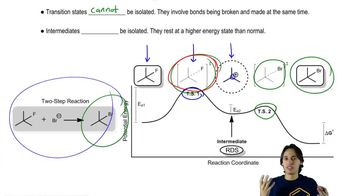
Transition state theory posits that during a chemical reaction, reactants pass through a high-energy transition state before forming products. This transition state represents the point of maximum energy along the reaction pathway and is crucial for understanding reaction mechanisms. Drawing the transition state involves illustrating the arrangement of atoms and bonds at this critical juncture, highlighting the breaking and forming of bonds.
Recommended video:
Guided course
06:55
Intermediates vs. Transition States

Free-Radical Chlorination

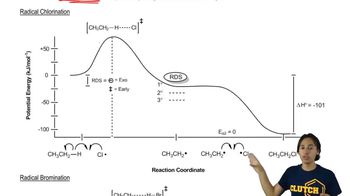
Free-radical chlorination is a reaction mechanism where chlorine atoms react with alkanes to form alkyl chlorides through a series of radical intermediates. This process involves the homolytic cleavage of Cl-Cl bonds to generate chlorine radicals, which then abstract hydrogen atoms from alkanes, leading to the formation of free radicals. The rate of chlorination can be significantly affected by the presence of isotopes, as seen in the comparison of methane and tetradeuteriomethane.
Recommended video:
Guided course
03:03
Using the Hammond Postulate to describe radical chlorination.
Related Practice
Textbook Question

Tributyltin hydride (Bu3SnH) is used synthetically to reduce alkyl halides, replacing a halogen atom with hydrogen. ­Free-radical initiators promote this reaction, and free-radical inhibitors are known to slow or stop it. Your job is to develop a mechanism, using the following reaction as the example.

The following bond-dissociation enthalpies may be helpful: 

b. Calculate values of ΔH for your proposed steps to show that they are energetically feasible. (Hint: A trace of Br2 and light suggests it’s there only as an initiator, to create Br• radicals. Then decide which atom can be abstracted most favorably from the starting materials by the Br• radical. That should complete the initiation. Finally, decide what energetically favored propagation steps will accomplish the reaction.)

2
views
Textbook Question

When healthy, Earth’s stratosphere contains a low concentration of ozone (O3) that absorbs potentially harmful ­ultraviolet (UV) radiation by the cycle shown at right.

Chlorofluorocarbon refrigerants, such as Freon 12 (CF2Cl2), are stable in the lower atmosphere, but in the stratosphere they absorb high-energy UV radiation to generate chlorine radicals.

The presence of a small number of chlorine radicals appears to lower ozone concentrations dramatically. The following reactions are all known to be exothermic (except the one requiring light) and to have high rate constants. Propose two mechanisms to explain how a small number of chlorine ­radicals can destroy large numbers of ozone molecules. Which of the two mechanisms is more likely when the concentration of chlorine atoms is very small?

8
views
Textbook Question

When a small amount of iodine is added to a mixture of chlorine and methane, it prevents chlorination from occurring. Therefore, iodine is a free-radical inhibitor for this reaction. Calculate ΔH° values for the possible reactions of iodine with species present in the chlorination of methane, and use these values to explain why iodine inhibits the reaction. (The I―Cl bond-dissociation enthalpy is 211 kJ/mol or 50 kcal/mol.)

2
views
Textbook Question

Iodination of alkanes using iodine (I2) is usually an unfavorable reaction. (See Problem 4-17 , for example.) Tetraiodomethane (CI4) can be used as the iodine source for iodination in the presence of a free-radical initiator such as hydrogen peroxide. Propose a mechanism (involving mildly exothermic propagation steps) for the following proposed reaction. Calculate the value of ΔH for each of the steps in your proposed mechanism.

The following bond-dissociation energies maybe helpful:

Textbook Question

Deuterium (D) is the hydrogen isotope of mass number 2, with a proton and a neutron in its nucleus. The chemistry of deuterium is nearly identical to the chemistry of hydrogen, except that the C―D bond is slightly stronger than the C―H bond by 5.0 kJ/mol (1.2 kcal/ mol). Reaction rates tend to be slower when a C―D bond (as opposed to a C―H bond) is broken in a rate-limiting step.

This effect, called a kinetic isotope effect, is clearly seen in the chlorination of methane. Methane undergoes free-radical chlorination 12 times as fast as tetradeuteriomethane (CD4).

c. Consider the thermodynamics of the chlorination of methane and the chlorination of ethane, and use the Hammond postulate to explain why one of these reactions has a much larger isotope effect than the other.

2
views
Textbook Question

Deuterium (D) is the hydrogen isotope of mass number 2, with a proton and a neutron in its nucleus. The chemistry of deuterium is nearly identical to the chemistry of hydrogen, except that the C―D bond is slightly stronger than the C―H bond by 5.0 kJ/mol (1.2 kcal/mol). Reaction rates tend to be slower when a C―D bond (as opposed to a C―H bond) is broken in a rate-limiting step.

This effect, called a kinetic isotope effect, is clearly seen in the chlorination of methane. Methane undergoes free-radical chlorination 12 times as fast as tetradeuteriomethane (CD4).

b. Monochlorination of deuterioethane (C2H5D) leads to a mixture containing 93% C2H4DCl and 7% C2H5Cl. Calculate the relative rates of abstraction per hydrogen and deuterium in the chlorination of deuterioethane.

7
views