Ch.4 - The Study of Chemical Reactions
Wade - Organic Chemistry 9th Edition
Wade9th EditionOrganic ChemistryISBN: 9780135213728Not the one you use?Change textbook
Chapter 4, Problem 10a,b

a. Using bond-dissociation enthalpies from Table 4-2. (page 167), calculate the heat of reaction for each step in the free-radical bromination of methane

b. Calculate the overall heat of the reaction.

Verified step by step guidance
1
Step 1: Identify the bonds broken and formed during the reaction. In the free-radical bromination of methane, the reaction involves breaking the Br-Br bond and the C-H bond in methane, and forming the C-Br bond in bromomethane and the H-Br bond.
Step 2: Use the bond-dissociation enthalpy values from Table 4-2 to determine the energy required to break the bonds. For the Br-Br bond, the bond-dissociation enthalpy is 190 kJ/mol. For the C-H bond in methane, the bond-dissociation enthalpy is 439 kJ/mol.
Step 3: Calculate the energy released when new bonds are formed. For the C-Br bond in bromomethane, the bond-dissociation enthalpy is 302 kJ/mol. For the H-Br bond, the bond-dissociation enthalpy is 366 kJ/mol.
Step 4: Determine the heat of reaction for each step by subtracting the total energy of bonds formed from the total energy of bonds broken. This gives the enthalpy change for the reaction.
Step 5: Calculate the overall heat of the reaction by summing the enthalpy changes for all steps. Ensure the sign of the enthalpy change reflects whether the reaction is exothermic or endothermic.

Verified video answer for a similar problem:

This video solution was recommended by our tutors as helpful for the problem above.
Video duration:
8m
Was this helpful?

Key Concepts

Here are the essential concepts you must grasp in order to answer the question correctly.

Bond-Dissociation Enthalpy

Bond-dissociation enthalpy is the energy required to break a specific bond in a molecule, resulting in the formation of free radicals. This concept is crucial for calculating the heat of reaction in free-radical bromination, as it allows for the quantification of energy changes associated with bond breaking and forming during the reaction.
Recommended video:
Guided course
04:09
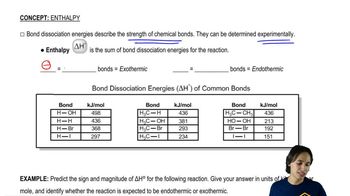
How to calculate enthalpy using bond dissociation energies.

Free-Radical Mechanism

The free-radical mechanism involves a series of steps where free radicals are generated and react with other molecules. In the bromination of methane, this mechanism includes initiation, propagation, and termination steps, each contributing to the overall heat of reaction. Understanding this mechanism is essential for analyzing the reaction pathway and energy changes.
Recommended video:
Guided course
03:28
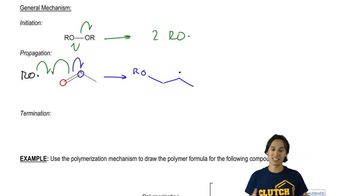
The mechanism of Radical Polymerization.

Heat of Reaction

The heat of reaction, or enthalpy change, is the difference in energy between reactants and products during a chemical reaction. It can be calculated by summing the bond-dissociation enthalpies of bonds broken and formed. This concept is vital for determining the overall energy change in the free-radical bromination of methane, as it reflects the stability of the products compared to the reactants.
Recommended video:
Guided course
03:01
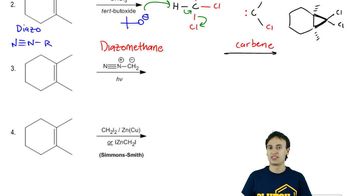
Reaction with diazomethane and light or heat.