
Textbook Question
There are eight different five-carbon alkyl groups.
c. In each case, label the degree of substitution (primary, secondary, or tertiary) of the head carbon atom bonded to the main chain.
1
views

 Verified step by step guidance
 00:34
00:34
 03:29
03:29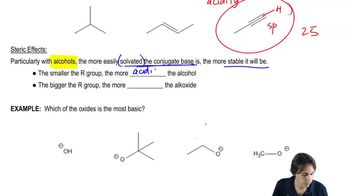 02:53
02:53There are eight different five-carbon alkyl groups.
c. In each case, label the degree of substitution (primary, secondary, or tertiary) of the head carbon atom bonded to the main chain.
In each pair of compounds, which compound has the higher boiling point? Explain your reasoning.
c. 2,2,5-trimethylhexane or nonane
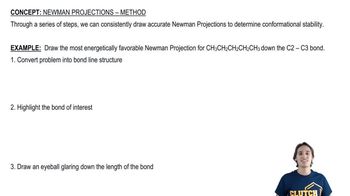
Use a Newman projection about the indicated bond to draw the most stable conformer for each compound.
b. 3,3-dimethylhexane about the C3―C4 bond
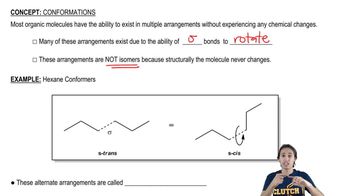
a. Draw the two chair conformations of cis-1,3-dimethylcyclohexane, and label all the positions as axial or equatorial.
b. Label the higher-energy conformation and the lower-energy conformation.
c. The energy difference in these two conformations has been measured to be about 23 kJ (5.4 kcal) per mole. How much of this energy difference is due to the torsional energy of gauche relationships?
d. How much energy is due to the additional steric strain of the 1,3-diaxial interaction?
There are eight different five-carbon alkyl groups.
a. Draw them.
b. Give them systematic names.
Draw the two chair conformations of each compound, and label the substituents as axial and equatorial. In each case, determine which conformation is more stable.
a. cis-1-ethyl-2-isopropylcyclohexane
b. trans-1-ethyl-2-isopropylcyclohexane