Ch.3 - Structure and Stereochemistry of Alkanes
Wade - Organic Chemistry 9th Edition
Wade9th EditionOrganic ChemistryISBN: 9780135213728Not the one you use?Change textbook
Chapter 3, Problem 31c,d

Name the following compounds.
(c) Line drawing of a bicyclic compound with labeled carbon atoms and bonds for identification and naming practice.
(d) Line drawing of a bicyclic compound with labeled sections for naming.

Verified step by step guidance
1
Step 1: Analyze the structure of compound c. The image shows a six-membered ring with one double bond. This indicates that the compound is a cycloalkene. The double bond introduces unsaturation into the ring.
Step 2: Determine the position of the double bond in compound c. Since no substituents are present, the double bond is assumed to be at the lowest possible position, which is between carbons 1 and 2.
Step 3: Name compound c using IUPAC nomenclature rules. The base name for a six-membered ring with one double bond is 'cyclohexene'.
Step 4: Analyze the structure of compound d. The image shows a six-membered ring with no double bonds or substituents. This indicates that the compound is a cycloalkane.
Step 5: Name compound d using IUPAC nomenclature rules. The base name for a six-membered ring with no double bonds is 'cyclohexane'.

Verified video answer for a similar problem:

This video solution was recommended by our tutors as helpful for the problem above.
Video duration:
3m
Was this helpful?

Key Concepts

Here are the essential concepts you must grasp in order to answer the question correctly.

Nomenclature

Nomenclature in organic chemistry refers to the systematic naming of chemical compounds based on established rules. The International Union of Pure and Applied Chemistry (IUPAC) provides guidelines that help chemists communicate the structure and composition of compounds clearly. Understanding nomenclature is essential for identifying and naming organic molecules accurately.
Recommended video:
4:02
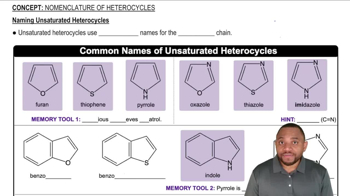
Nomenclature of Heterocycles Concept 2

Functional Groups

Functional groups are specific groups of atoms within molecules that are responsible for the characteristic chemical reactions of those molecules. Common functional groups include hydroxyl (-OH), carboxyl (-COOH), and amino (-NH2) groups. Recognizing functional groups is crucial for predicting the behavior and reactivity of organic compounds.
Recommended video:
Guided course
02:36
Identifying Functional Groups

Structural Isomers

Structural isomers are compounds that have the same molecular formula but different structural arrangements of atoms. This can lead to variations in physical and chemical properties. Understanding structural isomerism is important for accurately naming compounds and predicting their reactivity and interactions in organic chemistry.
Recommended video:
Guided course
01:10
What is a constitutional isomer?