
Ch.3 - Structure and Stereochemistry of Alkanes
Wade - Organic Chemistry 9th Edition
Wade9th EditionOrganic ChemistryISBN: 9780135213728Not the one you use?Change textbook
Chapter 3, Problem 6a

Give structures and names for
a. the five isomers of C6H14

Verified step by step guidance
1
Step 1: Understand the concept of isomers. Isomers are compounds with the same molecular formula but different structural arrangements. For C6H14, we are looking for structural isomers, which differ in the connectivity of atoms.
Step 2: Start with the simplest structure, which is the straight-chain alkane. For C6H14, this is hexane. Draw the structure as a linear chain of six carbon atoms, each bonded to enough hydrogen atoms to satisfy the tetravalency of carbon.
Step 3: Create the first branched isomer by shortening the main chain and adding a methyl group. For example, consider a five-carbon chain (pentane) and add a methyl group to the second carbon. This gives you 2-methylpentane.
Step 4: Continue creating branched isomers by varying the position of the methyl group. For instance, move the methyl group to the third carbon in the five-carbon chain to form 3-methylpentane.
Step 5: Explore further branching by considering a four-carbon chain (butane) and adding two methyl groups. Place one methyl group on the second carbon and another on the third carbon to form 2,3-dimethylbutane. Additionally, consider placing both methyl groups on the second carbon to form 2,2-dimethylbutane.

Verified video answer for a similar problem:

This video solution was recommended by our tutors as helpful for the problem above.
Video duration:
5m
Was this helpful?

Key Concepts

Here are the essential concepts you must grasp in order to answer the question correctly.

Isomerism

Isomerism refers to the phenomenon where compounds have the same molecular formula but different structural arrangements. In organic chemistry, structural isomers differ in the connectivity of atoms, leading to distinct physical and chemical properties. Understanding isomerism is crucial for identifying and naming different compounds with the same formula.
Recommended video:
Guided course
06:47
Monosaccharides - D and L Isomerism

Alkanes

Alkanes are saturated hydrocarbons consisting solely of carbon and hydrogen atoms connected by single bonds. They follow the general formula CnH2n+2, where n is the number of carbon atoms. Recognizing the structure and naming conventions of alkanes is essential for identifying isomers of C6H14, which is a hexane.
Recommended video:
Guided course
02:47
Functionalizing Alkanes

IUPAC Nomenclature

IUPAC nomenclature is the standardized system for naming chemical compounds. It involves identifying the longest carbon chain, numbering the chain to give substituents the lowest possible numbers, and naming branches or substituents. Mastery of IUPAC rules is necessary to correctly name the isomers of C6H14, ensuring clear communication in scientific contexts.
Recommended video:
Guided course
03:43
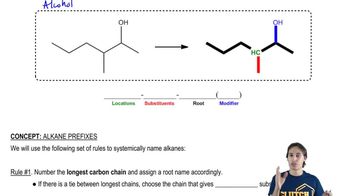
The different parts of an IUPAC name