
Ch.3 - Structure and Stereochemistry of Alkanes
Wade - Organic Chemistry 9th Edition
Wade9th EditionOrganic ChemistryISBN: 9780135213728Not the one you use?Change textbook
Chapter 3, Problem 46c,d

Draw the two chair conformations of each compound, and label the substituents as axial and equatorial. In each case, determine which conformation is more stable.
c. cis-1-ethyl-3-methylcyclohexane
d. trans-1-ethyl-3-methylcyclohexane

Verified step by step guidance
1
Start by drawing the basic structure of cyclohexane in its chair conformation. Remember that a chair conformation has alternating axial and equatorial positions for substituents.
For cis-1-ethyl-3-methylcyclohexane, place the ethyl group at carbon 1 and the methyl group at carbon 3. Since the compound is cis, both substituents should be on the same side of the cyclohexane ring. Draw one conformation with both substituents axial and another with both equatorial.
Label the substituents in each conformation as axial or equatorial. In the first conformation, if both substituents are axial, label them as such. In the second conformation, if both are equatorial, label them accordingly.
For trans-1-ethyl-3-methylcyclohexane, place the ethyl group at carbon 1 and the methyl group at carbon 3. Since the compound is trans, one substituent should be axial and the other equatorial. Draw one conformation with the ethyl group axial and the methyl group equatorial, and another with the ethyl group equatorial and the methyl group axial.
Determine the more stable conformation for each compound. Generally, the conformation with the larger substituents in the equatorial position is more stable due to reduced steric hindrance. Compare the stability of the conformations for both cis and trans isomers.

Verified video answer for a similar problem:

This video solution was recommended by our tutors as helpful for the problem above.
Video duration:
8m
Was this helpful?

Key Concepts

Here are the essential concepts you must grasp in order to answer the question correctly.

Chair Conformation

Chair conformation is a three-dimensional representation of cyclohexane that minimizes steric strain and torsional strain, making it the most stable conformation. It resembles a chair, with alternating axial and equatorial positions for substituents. Understanding this conformation is crucial for analyzing stability and steric interactions in substituted cyclohexanes.
Recommended video:
Guided course
03:29
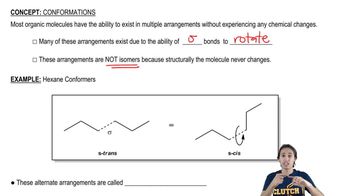
Understanding what a conformer is.

Axial and Equatorial Positions

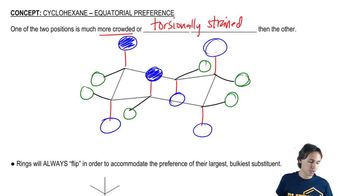
In cyclohexane chair conformations, substituents can occupy axial positions, which are parallel to the ring's axis, or equatorial positions, which are perpendicular to the axis. Equatorial positions are generally more stable due to reduced steric hindrance, especially for larger substituents. Identifying these positions helps determine the stability of different conformations.
Recommended video:
Guided course
04:02
Equatorial Preference

Cis and Trans Isomerism

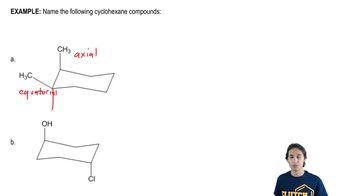
Cis and trans isomerism refers to the relative positioning of substituents on a cyclohexane ring. In cis isomers, substituents are on the same side, while in trans isomers, they are on opposite sides. This affects the steric interactions and stability of the molecule, influencing which chair conformation is more favorable.
Recommended video:
Guided course
00:44
Is the following cyclohexane cis or trans?
Related Practice
Textbook Question

Draw the two chair conformations of each compound, and label the substituents as axial and equatorial. In each case, determine which conformation is more stable.

e. cis-1-ethyl-4-methylcyclohexane

f. trans-1-ethyl-4-methylcyclohexane

1
views
Textbook Question

Convert each Newman projection to the equivalent line–angle formula, and assign the IUPAC name.

(a)

(b)

1
views
Textbook Question

Use a Newman projection about the indicated bond to draw the most stable conformer for each compound.

b. 3,3-dimethylhexane about the C3―C4 bond

1
views
Textbook Question

Using what you know about the conformational energetics of substituted cyclohexanes, predict which of the two decalin isomers is more stable. Explain your reasoning.

3
views
Textbook Question

a. Draw the two chair conformations of cis-1,3-dimethylcyclohexane, and label all the positions as axial or equatorial.

b. Label the higher-energy conformation and the lower-energy conformation.

c. The energy difference in these two conformations has been measured to be about 23 kJ (5.4 kcal) per mole. How much of this energy difference is due to the torsional energy of gauche relationships?

d. How much energy is due to the additional steric strain of the 1,3-diaxial interaction?

2
views
Textbook Question

Draw the two chair conformations of each compound, and label the substituents as axial and equatorial. In each case, determine which conformation is more stable.

a. cis-1-ethyl-2-isopropylcyclohexane

b. trans-1-ethyl-2-isopropylcyclohexane

1
views