
Ch. 24 - Amino Acids, Peptides, and Proteins
Wade - Organic Chemistry 9th Edition
Wade9th EditionOrganic ChemistryISBN: 9780135213728Not the one you use?Change textbook
Chapter 24, Problem 45a

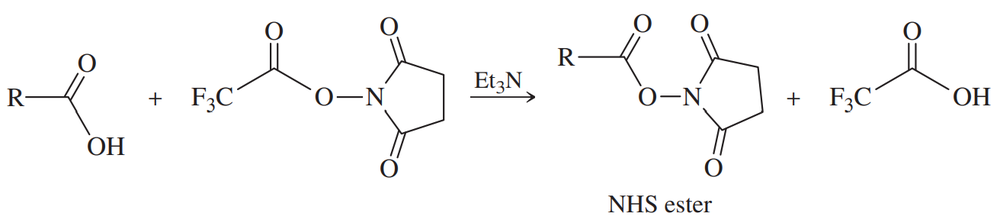
There are many methods for activating a carboxylic acid in preparation for coupling with an amine. The following method converts the acid to an N-hydroxysuccinimide (NHS) ester.
Reaction mechanism showing the conversion of a carboxylic acid to an NHS ester with an amine.
(a) Explain why an NHS ester is much more reactive than a simple alkyl ester.

Verified step by step guidance
1
Step 1: Begin by analyzing the chemical reaction provided in the image. The carboxylic acid (R-COOH) reacts with N-hydroxysuccinimide (NHS) and a coupling agent (such as a carbodiimide, e.g., DCC or EDC) to form an NHS ester. This reaction is facilitated by the presence of a base, triethylamine (Et3N).
Step 2: Understand the structural difference between an NHS ester and a simple alkyl ester. An alkyl ester has an alkyl group (-R') attached to the oxygen atom of the ester functional group, whereas an NHS ester has the N-hydroxysuccinimide moiety attached to the oxygen atom. The NHS moiety contains electron-withdrawing groups (carbonyl groups) that stabilize the leaving group.
Step 3: Explain the reactivity of the NHS ester. The NHS ester is much more reactive than a simple alkyl ester because the N-hydroxysuccinimide moiety is an excellent leaving group. When the NHS ester reacts with an amine, the leaving group (NHS) departs easily due to its resonance stabilization. This makes the coupling reaction with amines highly efficient.
Step 4: Highlight the role of resonance stabilization in the NHS ester. The N-hydroxysuccinimide moiety can delocalize electrons through its carbonyl groups, which stabilizes the negative charge on the leaving group after it departs. This stabilization lowers the activation energy for the reaction, increasing the reactivity of the NHS ester.
Step 5: Conclude by emphasizing the practical advantage of using NHS esters in organic synthesis. Their high reactivity makes them ideal for coupling reactions, particularly in peptide synthesis and bioconjugation, where efficient formation of amide bonds is required.

Verified video answer for a similar problem:

This video solution was recommended by our tutors as helpful for the problem above.
Video duration:
5m
Was this helpful?

Key Concepts

Here are the essential concepts you must grasp in order to answer the question correctly.

N-Hydroxysuccinimide (NHS) Ester

An NHS ester is a reactive derivative of a carboxylic acid formed by reacting the acid with N-hydroxysuccinimide. This structure enhances the electrophilicity of the carbonyl carbon, making it more susceptible to nucleophilic attack compared to simple alkyl esters. The NHS group stabilizes the leaving group during the reaction, facilitating the coupling with amines.
Recommended video:
2:21
Synthesis of Amino Acids: N-Phthalimidomalonic Ester Synthesis Example 2

Reactivity of Esters

The reactivity of esters is influenced by the nature of the leaving group and the steric hindrance around the carbonyl carbon. Simple alkyl esters have less electrophilic character due to the stability of their leaving groups, which are typically less reactive. In contrast, NHS esters have a better leaving group, which increases their reactivity in nucleophilic acyl substitution reactions.
Recommended video:
Guided course
02:39
Ester Nomenclature

Nucleophilic Acyl Substitution

Nucleophilic acyl substitution is a fundamental reaction in organic chemistry where a nucleophile attacks the carbonyl carbon of an acyl compound, leading to the replacement of a leaving group. This mechanism is crucial for the formation of amides from carboxylic acids and amines. The increased reactivity of NHS esters allows for more efficient coupling reactions with amines, making them valuable in peptide synthesis and other applications.
Recommended video:
Guided course
01:47
Nucleophiles and Electrophiles can react in Substitution Reactions.
Related Practice
Textbook Question

There are many methods for activating a carboxylic acid in preparation for coupling with an amine. The following method converts the acid to an N-hydroxysuccinimide (NHS) ester.

(b) Propose a mechanism for the reaction shown.

1
views
Textbook Question

Sometimes chemists need the unnatural D enantiomer of an amino acid, often as part of a drug or an insecticide. Most L-amino acids are isolated from proteins, but the D-amino acids are rarely found in natural proteins. D-amino acids can be synthesized from the corresponding L-amino acids. The following synthetic scheme is one of the possible methods.

(a) Draw the structures of intermediates 1 and 2 in this scheme.

(b) How do we know that the product is entirely the unnatural D configuration?

4
views
Textbook Question

Lipoic acid is often found near the active sites of enzymes, usually bound to the peptide by a long, flexible amide linkage with a lysine residue.


(a) Is lipoic acid a mild oxidizing agent or a mild reducing agent? Draw it in both its oxidized and reduced forms.

(b) Show how lipoic acid might react with two Cys residues to form a disulfide bridge.

(c) Give a balanced equation for the hypothetical oxidation or reduction, as you predicted in part (a), of an aldehyde by lipoic acid.

1
views
Textbook Question

Metabolism of arginine produces urea and the rare amino acid ornithine. Ornithine has an isoelectric point close to 10. Propose a structure for ornithine.

1
views
Textbook Question

There are many methods for activating a carboxylic acid in preparation for coupling with an amine. The following method converts the acid to an N-hydroxysuccinimide (NHS) ester.

(c) Propose a mechanism for the reaction of the NHS ester with an amine, R–NH2.

7
views
Textbook Question

Histidine is an important catalytic residue found at the active sites of many enzymes. In many cases, histidine appears to remove protons or to transfer protons from one location to another.

(a) Show which nitrogen atom of the histidine heterocycle is basic and which is not.

(b) Use resonance forms to show why the protonated form of histidine is a particularly stable cation.

(c) Show the structure that results when histidine accepts a proton on the basic nitrogen of the heterocycle and then is deprotonated on the other heterocyclic nitrogen. Explain how histidine might function as a pipeline to transfer protons between sites within an enzyme and its substrate.

1
views