Ch. 24 - Amino Acids, Peptides, and Proteins
Wade - Organic Chemistry 9th Edition
Wade9th EditionOrganic ChemistryISBN: 9780135213728Not the one you use?Change textbook
Chapter 24, Problem 30c

Show how you would synthesize any of the standard amino acids from each starting material. You may use any necessary reagents.
(c)

Verified step by step guidance
1
Identify the target amino acid you wish to synthesize. For example, if the target is alanine, note its structure: CH3-CH(NH2)-COOH. This will help you determine the functional groups and carbon skeleton required.
Choose an appropriate starting material. A common starting material for amino acid synthesis is an α-halo acid (e.g., a compound like CH3-CH(Cl)-COOH for alanine). Alternatively, you can use a simpler compound like an aldehyde or ketone, depending on the synthesis route.
Plan the introduction of the amino group (-NH2). A common method is to use the Gabriel synthesis or reductive amination. For example, if starting with an α-halo acid, you can replace the halogen with an amine group using reagents like NH3 (ammonia).
Ensure the carboxylic acid group (-COOH) is present or can be introduced. If starting with an aldehyde or ketone, you can use the Strecker synthesis, which involves reacting the compound with NH3 and HCN to form an aminonitrile, followed by hydrolysis to yield the amino acid.
Verify the stereochemistry of the product. Many amino acids are chiral, so you may need to use specific reagents or conditions to ensure the correct enantiomer is formed. For example, enzymatic resolution or chiral catalysts can be used to obtain the desired stereoisomer.

Verified video answer for a similar problem:

This video solution was recommended by our tutors as helpful for the problem above.
Video duration:
1m
Was this helpful?

Key Concepts

Here are the essential concepts you must grasp in order to answer the question correctly.

Amino Acid Structure

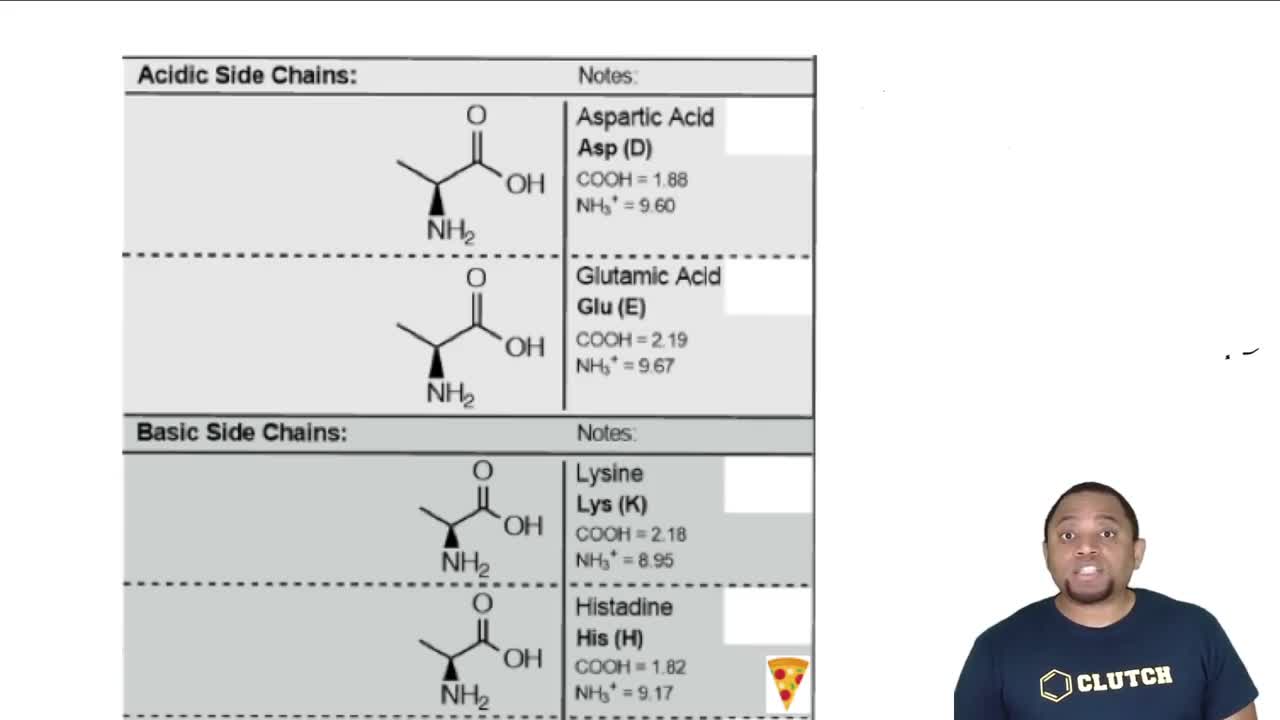
Amino acids are organic compounds characterized by a central carbon atom bonded to an amino group (-NH2), a carboxyl group (-COOH), a hydrogen atom, and a variable R group (side chain). The R group determines the specific properties and identity of each amino acid, influencing its role in protein synthesis and function.
Recommended video:
Guided course
11:14
Charged Amino Acids

Synthetic Pathways

The synthesis of amino acids can be achieved through various chemical pathways, including the Strecker synthesis and Gabriel synthesis. These methods involve specific reagents and conditions to construct the amino acid's backbone and functional groups, allowing for the transformation of simple starting materials into complex amino acids.
Recommended video:
2:13
Energy Production In Biochemical Pathways Concept 1

Reagents and Reaction Conditions

Understanding the appropriate reagents and reaction conditions is crucial for synthesizing amino acids. Common reagents include alkyl halides, amines, and carbonyl compounds, while reaction conditions such as temperature, pH, and solvent choice can significantly affect the yield and purity of the desired amino acid product.
Recommended video: