Ch. 24 - Amino Acids, Peptides, and Proteins
Wade - Organic Chemistry 9th Edition
Wade9th EditionOrganic ChemistryISBN: 9780135213728Not the one you use?Change textbook
Chapter 24, Problem 29g

Predict the products of the following reactions.
(g) 4-methylpentanoic acid + Br2/PBr3

Verified step by step guidance
1
Identify the type of reaction: The presence of Br2 and PBr3 suggests that this is a Hell-Volhard-Zelinsky (HVZ) reaction, which is specific to carboxylic acids. This reaction involves the alpha-bromination of the carboxylic acid.
Understand the mechanism: In the HVZ reaction, PBr3 first converts the carboxylic acid group (-COOH) into an acyl bromide (-COBr). This intermediate is more reactive and facilitates the subsequent steps.
Determine the alpha-bromination step: The acyl bromide undergoes enolization (formation of an enol intermediate) at the alpha-carbon (the carbon adjacent to the carbonyl group). The enol reacts with Br2, leading to the substitution of a hydrogen atom at the alpha-carbon with a bromine atom.
Account for the final product: After the alpha-bromination, the acyl bromide intermediate is hydrolyzed back to the carboxylic acid, regenerating the -COOH group while retaining the bromine atom at the alpha-carbon.
Write the product structure: The final product is 2-bromo-4-methylpentanoic acid, where the bromine atom is attached to the alpha-carbon of the original carboxylic acid.

Verified video answer for a similar problem:

This video solution was recommended by our tutors as helpful for the problem above.
Video duration:
1m
Was this helpful?

Key Concepts

Here are the essential concepts you must grasp in order to answer the question correctly.

Reactivity of Carboxylic Acids

Carboxylic acids, such as 4-methylpentanoic acid, are characterized by the presence of the carboxyl group (-COOH). This functional group is highly reactive, particularly in nucleophilic substitution reactions. Understanding how carboxylic acids react with halogens is crucial for predicting the products of the given reaction.
Recommended video:
Guided course
04:20
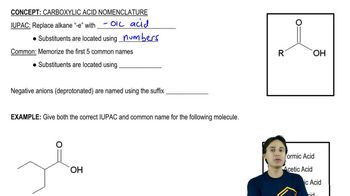
Carboxylic Acids Nomenclature

Halogenation Reactions

Halogenation involves the introduction of halogen atoms into organic compounds. In the presence of Br2 and PBr3, carboxylic acids can undergo halogenation at the alpha position (the carbon adjacent to the carboxyl group). This process is essential for predicting the products of the reaction involving 4-methylpentanoic acid.
Recommended video:
Guided course
03:45
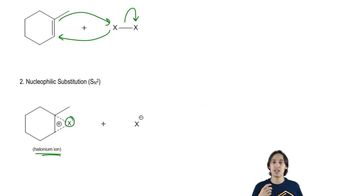
Halogenation Mechanism

Mechanism of Nucleophilic Substitution

Nucleophilic substitution is a fundamental reaction mechanism in organic chemistry where a nucleophile replaces a leaving group in a molecule. In the context of the reaction with 4-methylpentanoic acid, understanding the mechanism helps in predicting how the bromine will be incorporated into the molecule, leading to the formation of the final product.
Recommended video:
Guided course
01:47
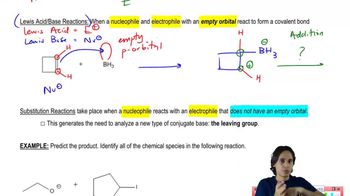
Nucleophiles and Electrophiles can react in Substitution Reactions.