Ch. 24 - Amino Acids, Peptides, and Proteins
Wade - Organic Chemistry 9th Edition
Wade9th EditionOrganic ChemistryISBN: 9780135213728Not the one you use?Change textbook
Chapter 24, Problem 2a

Most naturally occurring amino acids have chiral centers (the asymmetric α carbon atoms) that are named (S) by the Cahn–Ingold–Prelog convention (Section 5-3). The common naturally occurring form of cysteine has a chiral center that is named (R), however.
(a) What is the relationship between (R)-cysteine and (S)-alanine? Do they have the opposite three-dimensional configuration (as the names might suggest) or the same configuration?

Verified step by step guidance
1
Step 1: Understand the Cahn–Ingold–Prelog (CIP) convention for assigning (R) and (S) configurations. The configuration is determined by assigning priorities to the groups attached to the chiral center based on atomic number and then analyzing the spatial arrangement of these groups.
Step 2: Recognize that the (R) and (S) designations are specific to the molecule's structure and do not directly compare the three-dimensional configurations of two different molecules. Instead, they describe the priority order of substituents around the chiral center.
Step 3: Analyze the structure of (R)-cysteine. The chiral center in cysteine is the α-carbon, which is bonded to a hydrogen atom, a carboxyl group (-COOH), an amino group (-NH2), and a thiol group (-SH). The (R) configuration indicates a specific arrangement of these groups.
Step 4: Analyze the structure of (S)-alanine. The chiral center in alanine is also the α-carbon, which is bonded to a hydrogen atom, a carboxyl group (-COOH), an amino group (-NH2), and a methyl group (-CH3). The (S) configuration indicates a specific arrangement of these groups.
Step 5: Compare the spatial arrangements of the substituents in (R)-cysteine and (S)-alanine. Since the substituents differ (e.g., -SH in cysteine vs. -CH3 in alanine), the (R) and (S) designations do not imply opposite or identical three-dimensional configurations. Instead, they reflect the priority order of the substituents in each molecule. Therefore, the relationship between (R)-cysteine and (S)-alanine is not directly comparable in terms of three-dimensional configuration.

Verified video answer for a similar problem:

This video solution was recommended by our tutors as helpful for the problem above.
Was this helpful?

Key Concepts

Here are the essential concepts you must grasp in order to answer the question correctly.

Chirality

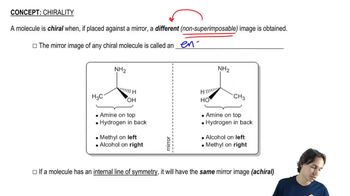
Chirality refers to the property of a molecule that makes it non-superimposable on its mirror image, much like left and right hands. In organic chemistry, chiral centers, typically carbon atoms bonded to four different substituents, create two distinct configurations known as enantiomers. Understanding chirality is crucial for distinguishing between different amino acids, as their biological functions can vary significantly based on their three-dimensional arrangement.
Recommended video:
Guided course
05:10
What is chirality?

Cahn–Ingold–Prelog (CIP) Priority Rules

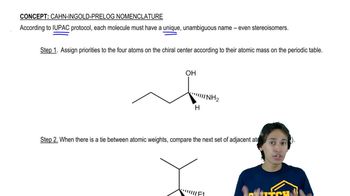
The Cahn–Ingold–Prelog (CIP) priority rules are a set of guidelines used to assign absolute configurations to chiral centers in molecules. By ranking the substituents attached to the chiral carbon based on atomic number and connectivity, chemists can determine whether the configuration is (R) or (S). This systematic approach is essential for accurately describing the stereochemistry of amino acids and understanding their relationships.
Recommended video:
Guided course
01:48
Why stereoisomers need their own naming system.

Enantiomers

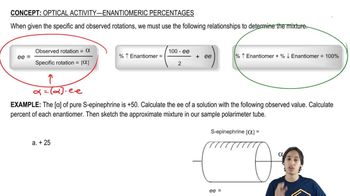
Enantiomers are pairs of molecules that are mirror images of each other and cannot be superimposed. They often exhibit different biological activities and properties, making their distinction important in fields like pharmacology. In the context of the question, understanding the relationship between (R)-cysteine and (S)-alanine involves recognizing whether they are enantiomers and how their configurations relate to one another.
Recommended video:
Guided course
03:23
How to solve for the percentage of each enantiomer.