Ch. 24 - Amino Acids, Peptides, and Proteins
Wade - Organic Chemistry 9th Edition
Wade9th EditionOrganic ChemistryISBN: 9780135213728Not the one you use?Change textbook
Chapter 24, Problem 4b

Draw the structure of the predominant form of
(b) proline at pH 2.

Verified step by step guidance
1
Step 1: Understand the structure of proline. Proline is an amino acid with a unique cyclic structure where the amino group is part of a five-membered ring. Its chemical formula is C5H9NO2, and it contains both an amino group (-NH2) and a carboxylic acid group (-COOH).
Step 2: Recall the behavior of amino acids at low pH. At pH 2, the environment is highly acidic, meaning there is an abundance of H⁺ ions. This causes the amino group to become protonated (-NH3⁺) and the carboxylic acid group to remain in its protonated form (-COOH).
Step 3: Identify the predominant form of proline at pH 2. Since the amino group is protonated and the carboxylic acid group is not deprotonated, the structure will include both -NH3⁺ and -COOH groups.
Step 4: Draw the structure of proline with the correct protonation states. Represent the cyclic structure with the amino group as -NH3⁺ and the carboxylic acid group as -COOH. Ensure the side chain and ring are accurately depicted.
Step 5: Verify the structure. Double-check that the protonation states match the conditions at pH 2 and that the cyclic structure of proline is correctly represented.

Verified video answer for a similar problem:

This video solution was recommended by our tutors as helpful for the problem above.
Video duration:
5m
Was this helpful?

Key Concepts

Here are the essential concepts you must grasp in order to answer the question correctly.

Amino Acid Structure

Amino acids are organic compounds that serve as the building blocks of proteins. Each amino acid has a central carbon atom bonded to an amino group (-NH2), a carboxyl group (-COOH), a hydrogen atom, and a variable side chain (R group). Proline is unique among amino acids due to its cyclic structure, where the side chain forms a ring with the amino group, affecting its properties and behavior in proteins.
Recommended video:
Guided course
11:14
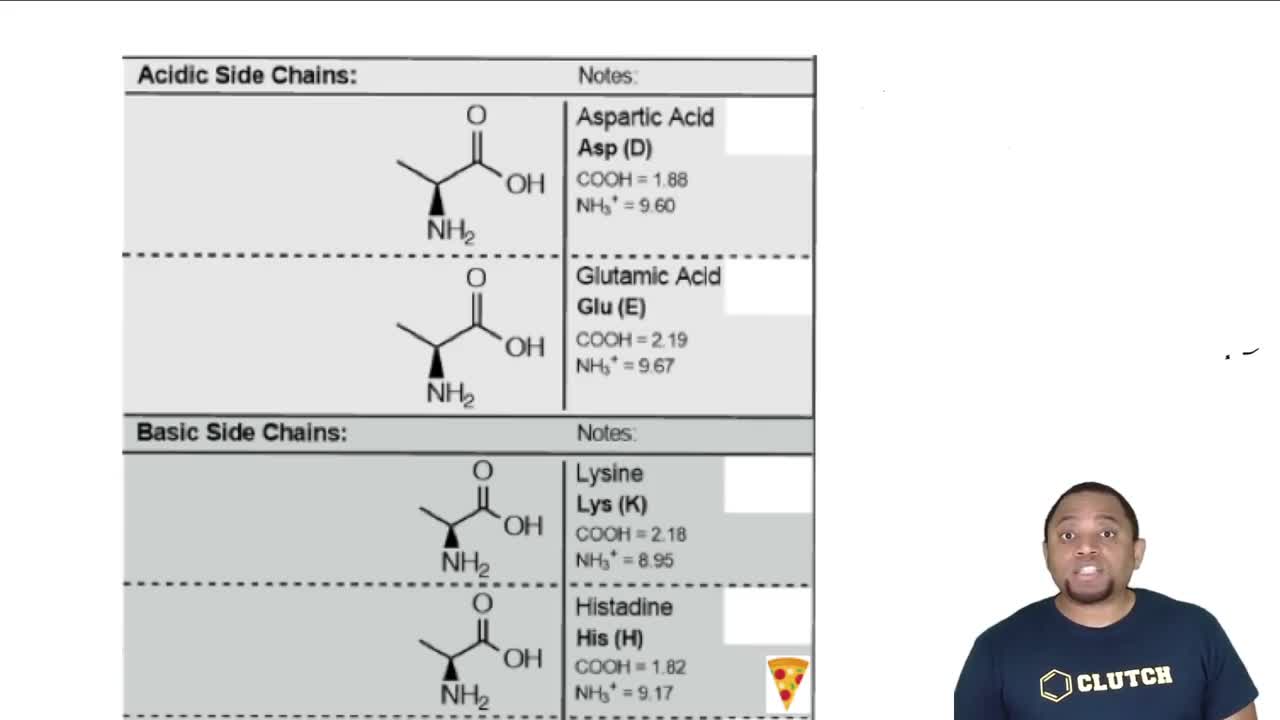
Charged Amino Acids

pH and Protonation

pH is a measure of the acidity or basicity of a solution, influencing the protonation state of functional groups in molecules. At low pH (acidic conditions), amino groups can be protonated to form -NH3+, while carboxyl groups can remain in their protonated form (-COOH). Understanding how pH affects the ionization of amino acids is crucial for predicting their predominant forms in different environments.
Recommended video:
Guided course
01:46
Why we use pKa instead of pH.

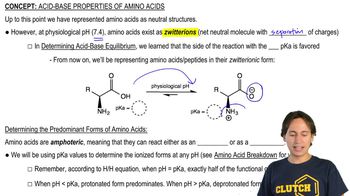
Zwitterion Formation

A zwitterion is a molecule that has both positive and negative charges, resulting in an overall neutral charge. In the case of proline at physiological pH, it exists predominantly as a zwitterion, where the amino group is protonated (-NH3+) and the carboxyl group is deprotonated (-COO-). This dual charge state is important for the solubility and reactivity of amino acids in biological systems.
Recommended video:
Guided course
04:41
Why Amino Acids Exist as Zwitterions