Ch. 24 - Amino Acids, Peptides, and Proteins
Wade - Organic Chemistry 9th Edition
Wade9th EditionOrganic ChemistryISBN: 9780135213728Not the one you use?Change textbook
Chapter 24, Problem 11b(2)

Propose a mechanism for each step in the synthesis in part (a).

Verified step by step guidance
1
Analyze the synthesis provided in part (a) and identify the starting material, reagents, and products for each step. This will help you understand the transformations occurring in the reaction sequence.
For each step, determine the type of reaction mechanism involved (e.g., nucleophilic substitution, elimination, electrophilic addition, etc.) based on the reagents and conditions provided.
Draw the detailed mechanism for the first step, showing all intermediates, electron-pushing arrows, and transition states if applicable. For example, if the step involves a nucleophilic attack, show the movement of electrons from the nucleophile to the electrophile.
Repeat the process for subsequent steps in the synthesis, ensuring that you account for all intermediates and products formed. Pay attention to stereochemistry, regiochemistry, and any rearrangements that may occur.
Review the entire mechanism to ensure it is consistent with the reagents, conditions, and products provided in part (a). Verify that all steps are chemically plausible and align with the principles of organic chemistry.

Verified video answer for a similar problem:

This video solution was recommended by our tutors as helpful for the problem above.
Video duration:
4m
Was this helpful?

Key Concepts

Here are the essential concepts you must grasp in order to answer the question correctly.

Reaction Mechanism

A reaction mechanism is a step-by-step description of how a chemical reaction occurs at the molecular level. It outlines the sequence of elementary steps, including bond breaking and formation, and the intermediates formed during the reaction. Understanding the mechanism is crucial for predicting the products and the conditions required for the reaction.
Recommended video:
Guided course
02:16
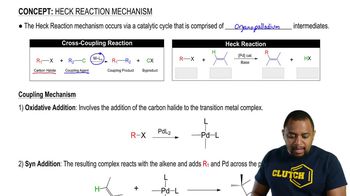
Heck Reaction Mechanism

Synthesis

Synthesis in organic chemistry refers to the process of constructing complex organic compounds from simpler ones through a series of chemical reactions. It involves selecting appropriate starting materials and reaction conditions to achieve the desired product. A well-planned synthesis pathway is essential for efficient and effective compound formation.
Recommended video:
1:16
Synthesis of Amino Acids: Strecker Synthesis Example 1

Intermediates

Intermediates are transient species that form during the course of a chemical reaction but are not present in the final product. They play a critical role in the reaction mechanism, as they can influence the rate and outcome of the reaction. Identifying intermediates helps chemists understand the pathway and control the synthesis process.
Recommended video:
Guided course
04:31
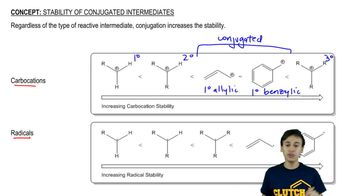
Stability of Conjugated Intermediates