Ch. 24 - Amino Acids, Peptides, and Proteins
Wade - Organic Chemistry 9th Edition
Wade9th EditionOrganic ChemistryISBN: 9780135213728Not the one you use?Change textbook
Chapter 24, Problem 36

Aspartame (Nutrasweet®) is a remarkably sweet-tasting dipeptide ester. Complete hydrolysis of aspartame gives phenyl alanine, aspartic acid, and methanol. Mild incubation with carboxypeptidase has no effect on aspartame. Treatment of aspartame with phenyl isothiocyanate, followed by mild hydrolysis, gives the phenylthiohydantoin of aspartic acid. Propose a structure for aspartame.

Verified step by step guidance
1
Understand the problem: Aspartame is a dipeptide ester that, upon complete hydrolysis, yields phenylalanine, aspartic acid, and methanol. This indicates that aspartame contains these components linked together in a specific structure. Additionally, the reaction with phenyl isothiocyanate and mild hydrolysis provides information about the N-terminal amino acid.
Analyze the hydrolysis products: Complete hydrolysis breaks all peptide bonds and ester bonds. The products—phenylalanine, aspartic acid, and methanol—suggest that aspartame is composed of these three components. Methanol indicates the presence of an ester group in the molecule.
Interpret the reaction with phenyl isothiocyanate: This reagent reacts with the free amino group of the N-terminal amino acid in a peptide to form a phenylthiohydantoin derivative. Since the phenylthiohydantoin of aspartic acid is obtained, aspartic acid must be the N-terminal amino acid in aspartame.
Consider the role of carboxypeptidase: Carboxypeptidase cleaves the C-terminal amino acid from peptides. The fact that mild incubation with carboxypeptidase has no effect on aspartame suggests that the C-terminal amino acid is blocked, likely due to the presence of an ester group.
Propose the structure: Based on the information, aspartame is a dipeptide with aspartic acid as the N-terminal amino acid and phenylalanine as the C-terminal amino acid. The C-terminal carboxyl group of phenylalanine is esterified with methanol. The structure can be represented as: Aspartic acid (N-terminal) - Phenylalanine (C-terminal) - Methyl ester.

Verified video answer for a similar problem:

This video solution was recommended by our tutors as helpful for the problem above.
Video duration:
14m
Was this helpful?

Key Concepts

Here are the essential concepts you must grasp in order to answer the question correctly.

Dipeptide Structure

A dipeptide consists of two amino acids linked by a peptide bond, formed through a condensation reaction that releases water. Understanding the structure of dipeptides is crucial for analyzing compounds like aspartame, which is composed of phenylalanine and aspartic acid. The arrangement of these amino acids determines the properties and reactivity of the dipeptide.
Recommended video:
Guided course
03:04
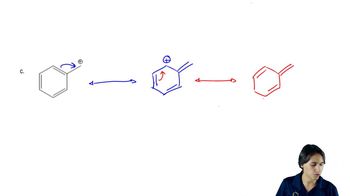
Drawing Resonance Structures

Hydrolysis of Peptides

Hydrolysis is a chemical reaction that involves the breaking of bonds in a molecule by the addition of water. In the context of aspartame, complete hydrolysis yields phenylalanine, aspartic acid, and methanol, indicating the breakdown of the dipeptide into its constituent parts. This process is essential for understanding how aspartame can be metabolized in the body.
Recommended video:
1:19
Peptide Sequencing: Partial Hydrolysis Concept 1

Phenylthiohydantoin (PTH) Derivatization

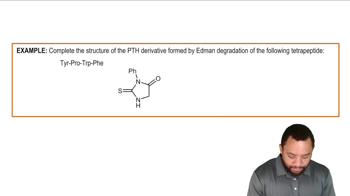
Phenylthiohydantoin (PTH) derivatization is a technique used in amino acid analysis, where amino acids react with phenyl isothiocyanate to form stable derivatives. This method is significant for identifying and characterizing amino acids in peptides, such as aspartic acid in aspartame. The formation of PTH derivatives allows for further analysis through techniques like chromatography.
Recommended video:
00:47
Peptide Sequencing: Edman Degradation Example 1
Related Practice
Textbook Question

Show how you would convert alanine to the following derivatives. Show the structure of the product in each case.

(c) N-benzyloxycarbonyl alanine

(d) tert-butyloxycarbonyl alanine

2
views

Textbook Question

Suggest a method for the synthesis of the unnatural D enantiomer of alanine from the readily available L enantiomer of lactic acid.

1
views
Textbook Question

Lipoic acid is often found near the active sites of enzymes, usually bound to the peptide by a long, flexible amide linkage with a lysine residue.


(a) Is lipoic acid a mild oxidizing agent or a mild reducing agent? Draw it in both its oxidized and reduced forms.

(b) Show how lipoic acid might react with two Cys residues to form a disulfide bridge.

(c) Give a balanced equation for the hypothetical oxidation or reduction, as you predicted in part (a), of an aldehyde by lipoic acid.

1
views
Textbook Question

Metabolism of arginine produces urea and the rare amino acid ornithine. Ornithine has an isoelectric point close to 10. Propose a structure for ornithine.

1
views
Textbook Question

Show how you would use the Strecker synthesis to make tryptophan. What stereochemistry would you expect in your synthetic product?

1
views
Textbook Question

Histidine is an important catalytic residue found at the active sites of many enzymes. In many cases, histidine appears to remove protons or to transfer protons from one location to another.

(a) Show which nitrogen atom of the histidine heterocycle is basic and which is not.

(b) Use resonance forms to show why the protonated form of histidine is a particularly stable cation.

(c) Show the structure that results when histidine accepts a proton on the basic nitrogen of the heterocycle and then is deprotonated on the other heterocyclic nitrogen. Explain how histidine might function as a pipeline to transfer protons between sites within an enzyme and its substrate.

1
views