Ch. 23 - Carbohydrates and Nucleic Acids
Wade - Organic Chemistry 9th Edition
Wade9th EditionOrganic ChemistryISBN: 9780135213728Not the one you use?Change textbook
Chapter 23, Problem 40

Trehalose is a nonreducing disaccharide (C12H22O11) isolated from the poisonous mushroom Amanita muscaria. Treatment with an α-glucosidase converts trehalose to two molecules of glucose, but no reaction occurs when trehalose is treated with a β-glucosidase. When trehalose is methylated by dimethyl sulfate in mild base and then hydrolyzed, the only product is 2,3,4,6-tetra-O-methylglucose. Propose a complete structure and systematic name for trehalose.

Verified step by step guidance
1
Step 1: Analyze the information provided about trehalose. Trehalose is a nonreducing disaccharide, meaning it does not have a free anomeric carbon capable of reducing other compounds. This suggests that both anomeric carbons in the two glucose units are involved in the glycosidic bond.
Step 2: Consider the enzymatic reaction with α-glucosidase and β-glucosidase. Trehalose is hydrolyzed by α-glucosidase but not by β-glucosidase. This indicates that the glycosidic bond in trehalose is an α-linkage, specifically an α,α-linkage between the two glucose units.
Step 3: Examine the methylation and hydrolysis results. When trehalose is methylated with dimethyl sulfate in a mild base, all hydroxyl groups except those involved in the glycosidic bond are methylated. Hydrolysis of the methylated product yields 2,3,4,6-tetra-O-methylglucose, indicating that the glycosidic bond involves the hydroxyl group at the 1-position of one glucose and the 1-position of the other glucose.
Step 4: Propose the structure of trehalose. Based on the above information, trehalose consists of two glucose units linked by an α,α-1,1-glycosidic bond. This structure satisfies the nonreducing nature of the disaccharide and the enzymatic specificity of α-glucosidase.
Step 5: Provide the systematic name for trehalose. The systematic name is α-D-glucopyranosyl-(1→1)-α-D-glucopyranoside, reflecting the α,α-1,1-glycosidic linkage between the two glucose units.

Verified video answer for a similar problem:

This video solution was recommended by our tutors as helpful for the problem above.
Video duration:
7m
Was this helpful?

Key Concepts

Here are the essential concepts you must grasp in order to answer the question correctly.

Disaccharides

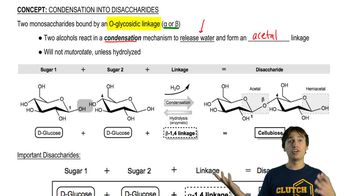
Disaccharides are carbohydrates formed by the condensation of two monosaccharide units, linked by a glycosidic bond. In the case of trehalose, it consists of two glucose molecules connected by an α(1→1) bond, making it a nonreducing sugar. Understanding the structure and properties of disaccharides is essential for analyzing their reactivity and behavior in biochemical processes.
Recommended video:

Glycosidic Bonds

Glycosidic bonds are covalent linkages that connect monosaccharides in carbohydrates. The type of glycosidic bond (α or β) determines the reactivity and properties of the sugar. In trehalose, the presence of an α-glycosidic bond explains why it can be hydrolyzed by α-glucosidase but not by β-glucosidase, highlighting the importance of bond type in enzymatic reactions.
Recommended video:
Guided course
06:00
Single bonds, double bonds, and triple bonds.

Methylation and Hydrolysis

Methylation is a chemical reaction that introduces methyl groups into a molecule, often used to protect hydroxyl groups in sugars. In the case of trehalose, methylation followed by hydrolysis yields 2,3,4,6-tetra-O-methylglucose, indicating that all hydroxyl groups were successfully methylated. This process is crucial for determining the structure of sugars and understanding their functional groups.
Recommended video:
1:00
Hydrolysis of Thioesters Concept 2