Ch. 23 - Carbohydrates and Nucleic Acids
Wade - Organic Chemistry 9th Edition
Wade9th EditionOrganic ChemistryISBN: 9780135213728Not the one you use?Change textbook
Chapter 23, Problem 24

Treatment of either anomer of fructose with excess ethanol in the presence of a trace of HCl gives a mixture of the α and β anomers of ethyl-D-fructofuranoside. Draw the starting materials, reagents, and products for this reaction. Circle the aglycone in each product.

Verified step by step guidance
1
Draw the structure of D-fructose, which is a ketohexose. Represent both the α and β anomers of D-fructose in their cyclic furanose forms (fructofuranose). These are the starting materials.
Add the reagent ethanol (CH₃CH₂OH) and indicate the presence of a trace amount of HCl as the catalyst. The HCl will protonate the anomeric hydroxyl group, making it a better leaving group.
Show the reaction mechanism where the anomeric hydroxyl group of D-fructofuranose is protonated by HCl, leading to the formation of a carbocation at the anomeric carbon. This is followed by nucleophilic attack by ethanol on the carbocation.
Draw the products of the reaction: the α and β anomers of ethyl-D-fructofuranoside. These are formed because the nucleophilic attack by ethanol can occur from either side of the planar carbocation intermediate.
Circle the aglycone in each product. The aglycone is the non-sugar part of the glycoside, which in this case is the ethyl group (CH₃CH₂O-). Clearly label the α and β anomers in the products.

Verified video answer for a similar problem:

This video solution was recommended by our tutors as helpful for the problem above.
Video duration:
5m
Was this helpful?

Key Concepts

Here are the essential concepts you must grasp in order to answer the question correctly.

Anomers

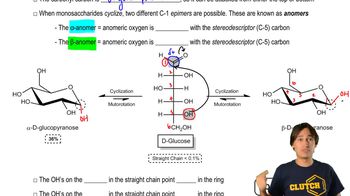
Anomers are a type of stereoisomer found in carbohydrates, specifically at the anomeric carbon, which is the carbon derived from the carbonyl carbon during the formation of a cyclic structure. In the case of fructose, the two anomers are designated as alpha (α) and beta (β), depending on the orientation of the hydroxyl group at the anomeric carbon. Understanding anomers is crucial for predicting the products of reactions involving sugars.
Recommended video:
Guided course
12:58
Monosaccharides - Cyclization

Furanose and Pyranose Forms

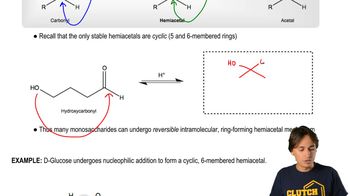
Furanose and pyranose refer to the cyclic forms of sugars, where furanose is a five-membered ring and pyranose is a six-membered ring. Fructose can exist in both forms, but in this reaction, the furanose form is specifically mentioned. Recognizing these structures is essential for understanding how sugars react with alcohols and acids, leading to glycoside formation.
Recommended video:
Guided course
06:23
Monosaccharides - Forming Cyclic Hemiacetals

Glycoside Formation

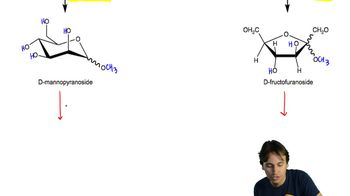
Glycoside formation is a chemical reaction where a sugar reacts with an alcohol in the presence of an acid catalyst, resulting in the formation of a glycosidic bond. In this case, the reaction of fructose with ethanol produces ethyl-d-fructofuranoside. This concept is vital for understanding how sugars can be modified to create various derivatives, which have significant implications in organic chemistry and biochemistry.
Recommended video:
Guided course
12:17
Predict the structure of the glycoside products