Ch. 23 - Carbohydrates and Nucleic Acids
Wade - Organic Chemistry 9th Edition
Wade9th EditionOrganic ChemistryISBN: 9780135213728Not the one you use?Change textbook
Chapter 23, Problem 11

The carbonyl group in D-galactose may be isomerized from C1 to C2 by brief treatment with dilute base (by the enediol rearrangement). The product is the C4 epimer of fructose. Draw the furanose structure of the product.

Verified step by step guidance
1
Identify the starting molecule, D-galactose, which is an aldohexose (a six-carbon sugar with an aldehyde group at C1). Understand that the enediol rearrangement involves the migration of the carbonyl group from C1 to C2 under basic conditions.
Recognize that the enediol rearrangement proceeds through the formation of an enediol intermediate. The base abstracts a proton from the alpha-carbon (C2), forming a resonance-stabilized enediol structure where the double bond is between C1 and C2, and hydroxyl groups are attached to both carbons.
After the enediol intermediate is formed, the carbonyl group reforms, but this time at C2 instead of C1. This converts the sugar from an aldose (aldehyde-containing sugar) to a ketose (ketone-containing sugar). The resulting ketose is D-fructose.
Determine the C4 epimer of D-fructose. An epimer is a stereoisomer that differs in configuration at only one stereogenic center. The C4 epimer of D-fructose is D-psicose, which has the opposite stereochemistry at C4 compared to D-fructose.
Draw the furanose structure of D-psicose. In the furanose form, the sugar adopts a five-membered ring structure. The ketone group at C2 reacts with the hydroxyl group at C5 to form a cyclic hemiketal. Ensure the stereochemistry at C4 reflects the epimeric difference from D-fructose.

Verified video answer for a similar problem:

This video solution was recommended by our tutors as helpful for the problem above.
Video duration:
5m
Was this helpful?

Key Concepts

Here are the essential concepts you must grasp in order to answer the question correctly.

Carbonyl Group and Isomerization

The carbonyl group (C=O) is a functional group found in aldehydes and ketones, playing a crucial role in organic reactions. Isomerization refers to the process where a compound is transformed into another compound with the same molecular formula but a different structure. In the context of D-galactose, the carbonyl group can shift from the C1 position to the C2 position, leading to the formation of an enediol intermediate, which is essential for the rearrangement.
Recommended video:
Guided course
06:47
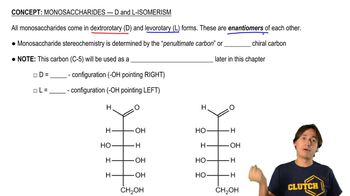
Monosaccharides - D and L Isomerism

Enediol Rearrangement

The enediol rearrangement is a chemical reaction where a carbonyl compound is converted into an enediol, which is a compound containing both a double bond and a hydroxyl group. This rearrangement allows for the migration of the carbonyl group, facilitating the formation of different isomers. In this case, the enediol form of D-galactose allows for the isomerization to produce a C4 epimer of fructose.
Recommended video:
Guided course
06:08
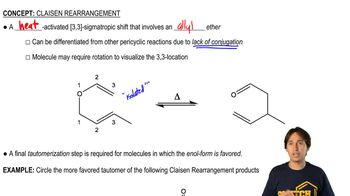
Definition of Claisen Rearrangement

Furanose Structure

Furanose refers to a five-membered ring structure formed by the cyclization of sugars, particularly those containing a carbonyl group. In the case of the C4 epimer of fructose, the furanose form is generated when the hydroxyl group on C2 reacts with the carbonyl carbon, resulting in a stable cyclic structure. Understanding the furanose structure is essential for visualizing the final product of the isomerization process described in the question.
Recommended video:
Guided course
03:04
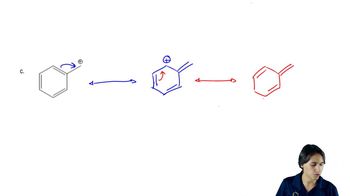
Drawing Resonance Structures