
Ch. 23 - Carbohydrates and Nucleic Acids
Wade - Organic Chemistry 9th Edition
Wade9th EditionOrganic ChemistryISBN: 9780135213728Not the one you use?Change textbook
Chapter 23, Problem 35b

In 1891, Emil Fischer determined the structures of glucose and the seven other D-aldohexoses using only simple chemical reactions and clever reasoning about stereochemistry and symmetry. He received the Nobel Prize for this work in 1902. Fischer had determined that D-glucose is an aldohexose, and he used Ruff degradations to degrade it to (+)-glyceraldehyde. Therefore, the eight D-aldohexose structures shown in Figure 23-3 are the possible structures for glucose.
Pretend that no names are shown in Figure 23-3 except for glyceraldehyde, and use the following results to prove which of these structures represent glucose, mannose, arabinose, and erythrose.
(b) Upon Ruff degradation, arabinose gives the aldotetrose erythrose. Nitric acid oxidation of erythrose gives an optically inactive aldaric acid, meso-tartaric acid. What is the structure of erythrose?

Verified step by step guidance
1
Step 1: Understand the Ruff degradation process. Ruff degradation is a method used to shorten the carbon chain of an aldose sugar by one carbon atom. It involves oxidation of the aldose to an aldonic acid, followed by decarboxylation. In this case, arabinose (a pentose sugar) is degraded to erythrose (a tetrose sugar).
Step 2: Analyze the nitric acid oxidation result. Nitric acid oxidation of erythrose produces an optically inactive aldaric acid, meso-tartaric acid. This indicates that erythrose must have a plane of symmetry, as meso compounds are achiral due to internal symmetry.
Step 3: Determine the stereochemistry of erythrose. Erythrose is a tetrose sugar with the molecular formula C4H8O4. Since it is optically inactive upon oxidation, the two chiral centers in erythrose must have opposite configurations, resulting in a meso compound upon oxidation.
Step 4: Draw the structure of erythrose. Erythrose has two chiral centers (C2 and C3). To achieve a plane of symmetry, the hydroxyl groups (-OH) on C2 and C3 must be on opposite sides. This configuration is D-erythrose, where the hydroxyl group on C2 is on the right, and the hydroxyl group on C3 is on the left.
Step 5: Verify the structure. Confirm that the drawn structure of erythrose matches the criteria: (1) It is a tetrose sugar, (2) It has two chiral centers, and (3) It produces meso-tartaric acid upon oxidation with nitric acid, confirming the presence of a plane of symmetry.

Verified video answer for a similar problem:

This video solution was recommended by our tutors as helpful for the problem above.
Video duration:
2m
Was this helpful?

Key Concepts

Here are the essential concepts you must grasp in order to answer the question correctly.

Aldoses and Ketoses

Aldoses are carbohydrates that contain an aldehyde group, while ketoses contain a ketone group. In the context of the question, d-aldohexoses like glucose are six-carbon sugars with an aldehyde functional group. Understanding the distinction between these two types of sugars is crucial for identifying their structures and reactivity, particularly in reactions like Ruff degradation.
Recommended video:

Ruff Degradation

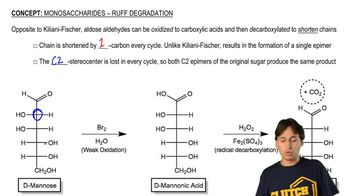
Ruff degradation is a chemical reaction used to break down aldoses into smaller sugars. This process involves the oxidation of the sugar followed by hydrolysis, which can help determine the structure of the original sugar by revealing its smaller components. In the question, the degradation of arabinose to erythrose illustrates how this method can be used to deduce the identities of different sugars.
Recommended video:
Guided course
06:18
Monosaccharides - Ruff Degradation

Stereochemistry and Optical Activity

Stereochemistry refers to the study of the spatial arrangement of atoms in molecules and how this affects their chemical behavior. Optical activity is a property of chiral molecules that can rotate plane-polarized light. The question mentions that nitric acid oxidation of erythrose yields meso-tartaric acid, which is optically inactive, indicating that it has a plane of symmetry. Understanding these concepts is essential for analyzing the structures and relationships between the sugars involved.
Recommended video:
Guided course
08:17
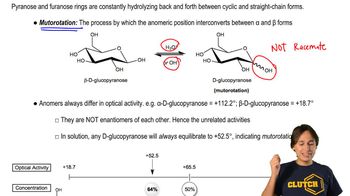
Mutorotation and Optical Activity
Related Practice
Textbook Question

In 1891, Emil Fischer determined the structures of glucose and the seven other D-aldohexoses using only simple chemical reactions and clever reasoning about stereochemistry and symmetry. He received the Nobel Prize for this work in 1902. Fischer had determined that D-glucose is an aldohexose, and he used Ruff degradations to degrade it to (+)-glyceraldehyde. Therefore, the eight D-aldohexose structures shown in Figure 23-3 are the possible structures for glucose.

Pretend that no names are shown in Figure 23-3 except for glyceraldehyde, and use the following results to prove which of these structures represent glucose, mannose, arabinose, and erythrose.

(a) Upon Ruff degradation, glucose and mannose give the same aldopentose: arabinose. Nitric acid oxidation of arabinose gives an optically active aldaric acid. What are the two possible structures of arabinose?

1
views
Textbook Question

The Wohl degradation, an alternative to the Ruff degradation, is nearly the reverse of the Kiliani–Fischer synthesis. The aldose carbonyl group is converted to the oxime, which is dehydrated by acetic anhydride to the nitrile (a cyanohydrin). Cyanohydrin formation is reversible, and a basic hydrolysis allows the cyanohydrin to lose HCN. Using the following sequence of reagents, give equations for the individual reactions in the Wohl degradation of D-arabinose to D-erythrose. Mechanisms are not required.

a. hydroxylamine hydrochloride

b. acetic anhydride

c. OH, H2O

Textbook Question

Draw the structures of the individual mutarotating α and β anomers of maltose.

Textbook Question

Give an equation to show the reduction of Tollens reagent by maltose.

Textbook Question

Ruff degradation of D-arabinose gives D-erythrose. The Kiliani–Fischer synthesis converts D-erythrose to a mixture of D-arabinose and D-ribose. Draw out these reactions, and give the structure of D-ribose.

1
views
Textbook Question

Does lactose mutarotate? Is it a reducing sugar? Explain. Draw the two anomeric forms of lactose