

Ch. 23 - Carbohydrates and Nucleic Acids
Wade - Organic Chemistry 9th Edition
Wade9th EditionOrganic ChemistryISBN: 9780135213728Not the one you use?Change textbook
Chapter 23, Problem 19b

Except for the Tollens test, basic aqueous conditions are generally avoided with sugars because they lead to fast isomerizations.

(b) Propose a mechanism for the isomerization of a ketose to an aldose, via the enediol intermediate, shown immediately above. Note that the enediol has two –OH protons, and removing one or the other gives two different enolate ions.

Verified step by step guidance
1
Identify the starting ketose structure and recognize that the isomerization involves the conversion of a ketose to an aldose through an enediol intermediate. This process occurs under basic aqueous conditions.
Understand that the first step involves deprotonation of the α-hydrogen (adjacent to the carbonyl group) of the ketose by a base (e.g., OH⁻). This forms an enolate ion, which is stabilized by resonance.
The enolate ion undergoes protonation at the oxygen atom of the carbonyl group, leading to the formation of the enediol intermediate. The enediol contains two hydroxyl (-OH) groups attached to adjacent carbons.
Recognize that the enediol intermediate can lose a proton from either of its hydroxyl groups. If the proton is removed from the hydroxyl group on the carbon adjacent to the original carbonyl carbon, it forms a new enolate ion that can rearrange to an aldose structure.
Finally, the enolate ion is protonated at the carbonyl carbon to regenerate a carbonyl group, completing the isomerization and forming the aldose. This step restores the neutral molecule and concludes the mechanism.

Verified video answer for a similar problem:

This video solution was recommended by our tutors as helpful for the problem above.
Video duration:
8m
Was this helpful?

Key Concepts

Here are the essential concepts you must grasp in order to answer the question correctly.

Isomerization

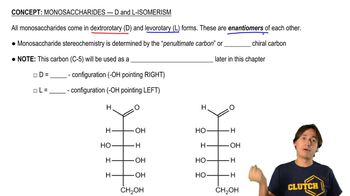
Isomerization is a chemical process where a compound is transformed into another compound with the same molecular formula but a different arrangement of atoms. In the context of sugars, isomerization can occur between ketoses and aldoses, affecting their reactivity and properties. Understanding this process is crucial for predicting how sugars behave under different conditions, particularly in aqueous environments.
Recommended video:
Guided course
06:47
Monosaccharides - D and L Isomerism

Enediol Intermediate

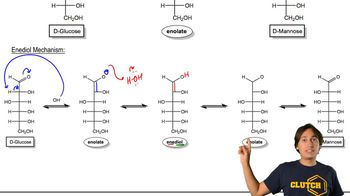
An enediol intermediate is a species that contains a carbon-carbon double bond adjacent to a hydroxyl group. This structure is pivotal in the isomerization of sugars, as it allows for the interconversion between ketoses and aldoses. The presence of two hydroxyl protons in the enediol enables the formation of different enolate ions, which are key to the mechanism of isomerization.
Recommended video:
Guided course
02:08
Enediol Mechanism

Enolate Ion

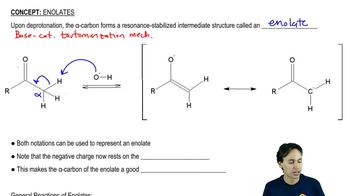
An enolate ion is a resonance-stabilized anion formed by the deprotonation of a carbon adjacent to a carbonyl group. In the context of sugar isomerization, the formation of enolate ions from the enediol intermediate is essential for the conversion between ketoses and aldoses. The choice of which hydroxyl proton to remove leads to different enolate structures, influencing the pathway and outcome of the isomerization reaction.
Recommended video:
Guided course
02:26
Formation of Enolates