Ch. 23 - Carbohydrates and Nucleic Acids
Wade - Organic Chemistry 9th Edition
Wade9th EditionOrganic ChemistryISBN: 9780135213728Not the one you use?Change textbook
Chapter 23, Problem 59c

Sugar X is known to be a D-aldohexose. On oxidation with HNO3, X gives an optically inactive aldaric acid. When X is degraded to an aldopentose, oxidation of the aldopentose gives an optically active aldaric acid. Determine the structure of X.

Verified step by step guidance
1
Identify the key characteristics of sugar X: It is a d-aldohexose, and upon oxidation with HNO₃, it produces an optically inactive aldaric acid. This indicates that sugar X must have a plane of symmetry in its structure, making it a meso compound.
Recall that aldaric acids are formed when both the aldehyde group and the terminal primary alcohol group of an aldose are oxidized to carboxylic acids. For the aldaric acid to be optically inactive, the d-aldohexose must have symmetrical stereochemistry.
List the possible d-aldohexoses and identify the one with a plane of symmetry. Among the d-aldohexoses, d-galactose and d-mannose do not have symmetry, but d-glucose and d-idose are potential candidates. Analyze their stereochemistry to confirm which one is meso.
Consider the degradation of sugar X to an aldopentose. This process involves the removal of one carbon atom from the chain, typically through the Ruff degradation. The resulting aldopentose, when oxidized, gives an optically active aldaric acid. This indicates that the aldopentose lacks symmetry.
Based on the above observations, deduce that sugar X must be d-glucose. Its symmetrical stereochemistry explains the formation of an optically inactive aldaric acid, and its degradation to an aldopentose (d-arabinose) aligns with the production of an optically active aldaric acid upon oxidation.

Verified video answer for a similar problem:

This video solution was recommended by our tutors as helpful for the problem above.
Video duration:
6m
Was this helpful?

Key Concepts

Here are the essential concepts you must grasp in order to answer the question correctly.

D-Aldohexose

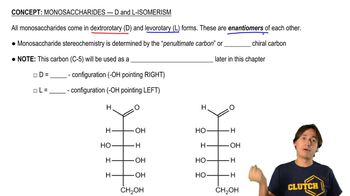
D-aldohexoses are a class of sugars characterized by having six carbon atoms and an aldehyde functional group. The 'D' designation indicates the configuration of the sugar, specifically that the hydroxyl group on the penultimate carbon is on the right in a Fischer projection. Understanding the structure of D-aldohexoses is crucial for determining the specific sugar in question, as it influences its reactivity and the products formed during oxidation.
Recommended video:
Guided course
06:47
Monosaccharides - D and L Isomerism

Aldaric Acid

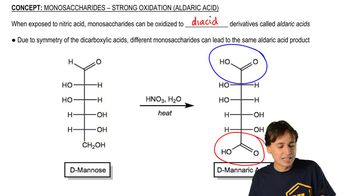
Aldaric acids are dicarboxylic acids derived from aldoses through oxidation of both the aldehyde and the primary alcohol groups. The formation of an optically inactive aldaric acid from sugar X upon oxidation suggests that the oxidation process leads to a symmetrical compound, which does not exhibit optical activity. This concept is essential for analyzing the oxidation reactions and understanding the stereochemical implications of the products formed.
Recommended video:
Guided course
03:10
Monosaccharides - Strong Oxidation (Aldaric Acid)

Optical Activity

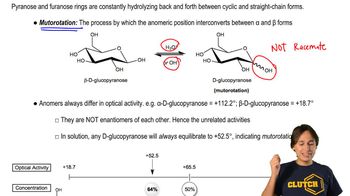
Optical activity refers to the ability of a compound to rotate plane-polarized light, a property that arises from the presence of chiral centers in the molecule. In the context of the question, the formation of an optically active aldaric acid from the aldopentose indicates that the aldopentose retains chirality after oxidation. This concept is vital for determining the stereochemical nature of the compounds involved and for deducing the structure of sugar X based on its oxidation products.
Recommended video:
Guided course
08:17
Mutorotation and Optical Activity
Related Practice
Textbook Question

Which of the D-aldopentoses will give optically active aldaric acids on oxidation with HNO3?

Textbook Question

When the gum of the shrub Sterculia setigera is subjected to acidic hydrolysis, one of the water-soluble components of the hydrolysate is found to be tagatose. The following information is known about tagatose:

(1) Molecular formula C6H12O6

(2) Undergoes mutarotation.

(3) Does not react with bromine water.

(4) Reduces Tollens reagent to give D-galactonic acid and D-talonic acid.

(5) Methylation of tagatose (using excess CH3I and Ag2O) followed by acidic hydrolysis gives 1,3,4,5-tetra-O-methyltagatose.

(a) Draw a Fischer projection structure for the open-chain form of tagatose.

3
views
Textbook Question

An unknown reducing disaccharide is found to be unaffected by invertase enzymes. Treatment with an α-galactosidase cleaves the disaccharide to give one molecule of D-fructose and one molecule of D-galactose. When the disaccharide is treated with excess iodomethane and silver oxide and then hydrolyzed in dilute acid, the products are 2,3,4,6-tetra-O-methylgalactose and 1,3,4-tri-O-methylfructose. Propose a structure for this disaccharide, and give its complete systematic name.

6
views
Textbook Question

Which of the D-aldotetroses will give optically active aldaric acids on oxidation with HNO3?

1
views
Textbook Question

Even though sugar X gives an optically inactive aldaric acid, the pentose formed by degradation gives an optically active aldaric acid. Does this finding contradict the principle that optically inactive reagents cannot form optically active products?

Textbook Question

Show what product results if the aldopentose formed from degradation of X is further degraded to an aldotetrose. Does HNO3 oxidize this aldotetrose to an optically active aldaric acid?

1
views