Ch. 23 - Carbohydrates and Nucleic Acids
Wade - Organic Chemistry 9th Edition
Wade9th EditionOrganic ChemistryISBN: 9780135213728Not the one you use?Change textbook
Chapter 23, Problem 8

Allose is the C3 epimer of glucose. Draw the cyclic hemiacetal form of D-allose, first in the chair conformation and then in the Haworth projection.

Verified step by step guidance
1
Understand the problem: D-Allose is the C3 epimer of D-Glucose, meaning it differs from D-Glucose only at the configuration of the hydroxyl group on the third carbon. The task is to draw the cyclic hemiacetal form of D-Allose in both the chair conformation and the Haworth projection.
Step 1: Start with the Fischer projection of D-Allose. Since it is the C3 epimer of D-Glucose, the hydroxyl group on the third carbon (C3) will point to the left, while the other hydroxyl groups (C2, C4, and C5) will have the same configuration as in D-Glucose. The aldehyde group is at C1, and the primary alcohol group is at C6.
Step 2: Form the cyclic hemiacetal. The hydroxyl group on C5 will attack the carbonyl carbon (C1) to form a six-membered ring (pyranose form). This creates a new chiral center at C1, known as the anomeric carbon. Draw both the α-anomer (where the hydroxyl group on C1 is trans to the CH2OH group at C5) and the β-anomer (where the hydroxyl group on C1 is cis to the CH2OH group).
Step 3: Draw the Haworth projection. To convert the cyclic structure into the Haworth projection, place the oxygen atom of the ring at the top right. Arrange the substituents around the ring based on the Fischer projection: groups on the right in the Fischer projection point down in the Haworth projection, and groups on the left point up. Ensure the CH2OH group at C5 is above the plane for D-sugars.
Step 4: Draw the chair conformation. Convert the Haworth projection into the chair conformation by arranging the six-membered ring in a 3D perspective. Place the substituents (hydroxyl groups and hydrogen atoms) in axial or equatorial positions based on their steric preferences. Typically, larger groups prefer equatorial positions to minimize steric hindrance.

Verified video answer for a similar problem:

This video solution was recommended by our tutors as helpful for the problem above.
Was this helpful?

Key Concepts

Here are the essential concepts you must grasp in order to answer the question correctly.

Epimers

Epimers are a specific type of diastereomer that differ in configuration at only one stereogenic center. In the case of allose and glucose, they differ at the C3 carbon atom. Understanding epimerism is crucial for distinguishing between similar sugars and predicting their reactivity and properties.
Recommended video:
Guided course
03:42
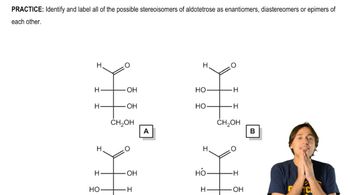
Identifying Types of Stereoisomers

Cyclic Hemiacetals

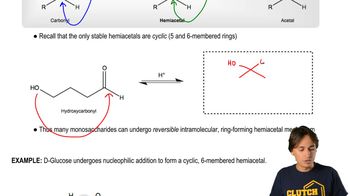
Cyclic hemiacetals are formed when an aldehyde or ketone reacts with an alcohol, resulting in a ring structure. In sugars, this process occurs when the hydroxyl group on the sugar reacts with the carbonyl group, leading to the formation of a stable cyclic form. Recognizing this transformation is essential for drawing the correct structures of sugars like allose.
Recommended video:
Guided course
06:23
Monosaccharides - Forming Cyclic Hemiacetals

Chair Conformation and Haworth Projection

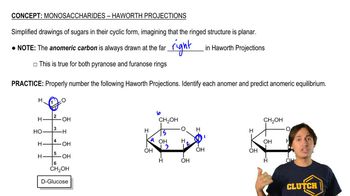
The chair conformation is a three-dimensional representation of cyclohexane rings that minimizes steric strain, making it a common way to depict cyclic sugars. The Haworth projection is a two-dimensional representation that simplifies the depiction of cyclic structures. Understanding both forms is important for accurately illustrating the structure of D-allose and its stereochemistry.
Recommended video:
Guided course
04:03
Monosaccharides - Haworth Projections