Ch. 22 - Condensations and Alpha Substitutions of Carbonyl Compounds
Wade - Organic Chemistry 9th Edition
Wade9th EditionOrganic ChemistryISBN: 9780135213728Not the one you use?Change textbook
Chapter 22, Problem 46d

Show the resonance forms for the enolate ions that result when the following compounds are treated with a strong base.
(d) nitroacetone

Verified step by step guidance
1
Identify the alpha-hydrogen in nitroacetone. The alpha-hydrogen is the hydrogen atom attached to the carbon adjacent to the carbonyl group (C=O). This hydrogen is acidic due to the electron-withdrawing effects of both the carbonyl group and the nitro group (-NO₂).
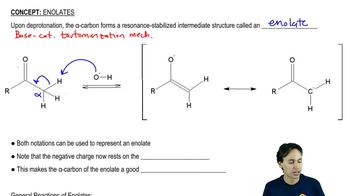
When a strong base is added, it abstracts the alpha-hydrogen, forming an enolate ion. The enolate ion consists of a negatively charged oxygen (from the carbonyl group) and a delocalized negative charge on the alpha-carbon.
Draw the first resonance structure of the enolate ion. In this structure, the negative charge is localized on the oxygen atom of the carbonyl group, forming an alkoxide ion. The double bond remains between the alpha-carbon and the carbonyl carbon.
Draw the second resonance structure of the enolate ion. In this structure, the negative charge is delocalized onto the alpha-carbon. The double bond shifts from the alpha-carbon to the carbonyl carbon, and the oxygen atom regains its double bond (C=O).
Consider the additional electron-withdrawing effect of the nitro group (-NO₂). The nitro group stabilizes the enolate ion further by delocalizing the negative charge through resonance. Draw a resonance structure where the negative charge is delocalized onto the nitro group, showing the interaction between the alpha-carbon and the nitro group.

Verified video answer for a similar problem:

This video solution was recommended by our tutors as helpful for the problem above.
Video duration:
4m
Was this helpful?

Key Concepts

Here are the essential concepts you must grasp in order to answer the question correctly.

Enolate Ion Formation

Enolate ions are formed when a carbonyl compound, such as a ketone or aldehyde, is deprotonated at the alpha carbon by a strong base. This results in a resonance-stabilized anion where the negative charge can be delocalized between the alpha carbon and the carbonyl oxygen, enhancing the stability of the enolate ion.
Recommended video:
Guided course
02:26
Formation of Enolates

Resonance Structures

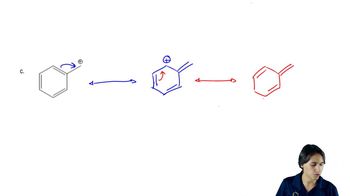
Resonance structures are different Lewis structures for the same molecule that illustrate the delocalization of electrons. In the case of enolate ions, resonance forms show how the negative charge can be represented on different atoms, providing insight into the stability and reactivity of the ion. These structures help visualize the electron distribution and the potential sites for nucleophilic attack.
Recommended video:
Guided course
03:04
Drawing Resonance Structures

Nitroacetone Reactivity

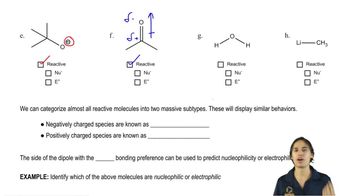
Nitroacetone is a compound that contains both a nitro group and a carbonyl group, which influences its reactivity. The presence of the electron-withdrawing nitro group increases the acidity of the alpha hydrogen, making it more susceptible to deprotonation by a strong base. This characteristic is crucial for understanding the formation of enolate ions from nitroacetone.
Recommended video:
Guided course
01:17
Reactivity of Molecules