Ch. 22 - Condensations and Alpha Substitutions of Carbonyl Compounds
Wade - Organic Chemistry 9th Edition
Wade9th EditionOrganic ChemistryISBN: 9780135213728Not the one you use?Change textbook
Chapter 22, Problem 68c

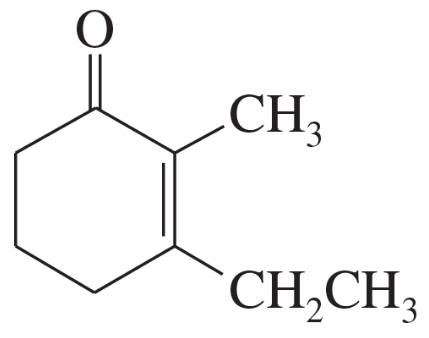
Show how you would use an aldol, Claisen, or another type of condensation to make each compound.
(c)

Verified step by step guidance
1
Step 1: Analyze the target molecule. The compound shown is a β-keto compound with a cyclopentane ring and a methyl group attached to the β-carbon. This suggests that it can be synthesized using an aldol condensation reaction.
Step 2: Identify the starting materials. To form the β-keto structure, you need an enolate donor and a carbonyl acceptor. The enolate donor could be acetone (CH3COCH3), and the acceptor could be cyclopentanone (C5H8O).
Step 3: Generate the enolate. Treat acetone with a base such as NaOH or LDA to form the enolate ion. This enolate will act as the nucleophile in the reaction.
Step 4: Perform the aldol addition. The enolate ion attacks the carbonyl carbon of cyclopentanone, forming a β-hydroxyketone intermediate. This step involves nucleophilic addition.
Step 5: Dehydrate the β-hydroxyketone. Heat the intermediate under acidic or basic conditions to remove water and form the α,β-unsaturated ketone. This completes the aldol condensation, yielding the target molecule.

Verified video answer for a similar problem:

This video solution was recommended by our tutors as helpful for the problem above.
Video duration:
3m
Was this helpful?

Key Concepts

Here are the essential concepts you must grasp in order to answer the question correctly.

Aldol Condensation

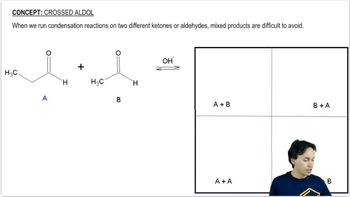
Aldol condensation is a reaction between aldehydes or ketones that contain alpha-hydrogens, leading to the formation of β-hydroxy aldehydes or ketones. This reaction involves the nucleophilic addition of an enolate ion to a carbonyl compound, followed by dehydration to yield an α,β-unsaturated carbonyl compound. It is a key reaction in organic synthesis for forming carbon-carbon bonds.
Recommended video:
Guided course
09:51
Crossed Aldol

Claisen Condensation

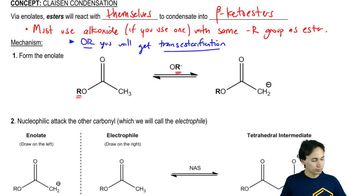
Claisen condensation is a reaction between two esters or an ester and a carbonyl compound in the presence of a strong base, resulting in the formation of a β-keto ester or a β-diketone. This reaction involves the formation of an enolate ion from one ester, which then attacks the carbonyl carbon of another ester, followed by subsequent hydrolysis. It is essential for constructing complex molecules in organic chemistry.
Recommended video:
Guided course
08:28
Claisen Condensation

Condensation Reactions

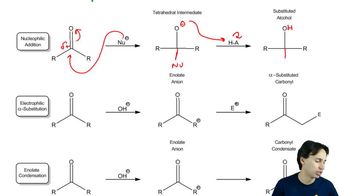
Condensation reactions are a class of reactions where two molecules combine to form a larger molecule, typically with the loss of a small molecule such as water or alcohol. In organic chemistry, these reactions are crucial for building larger, more complex structures from simpler precursors. Understanding the mechanisms and conditions for these reactions is vital for effective synthesis in organic chemistry.
Recommended video:
Guided course
05:53
Condensation Reactions