Ch. 22 - Condensations and Alpha Substitutions of Carbonyl Compounds
Wade - Organic Chemistry 9th Edition
Wade9th EditionOrganic ChemistryISBN: 9780135213728Not the one you use?Change textbook
Chapter 22, Problem 9c

Show how you would accomplish each conversion using an enamine synthesis with pyrrolidine as the secondary amine.
(c)

Verified step by step guidance
1
Step 1: Begin with acetophenone as the starting material. React acetophenone with pyrrolidine, a secondary amine, under acidic conditions to form the enamine intermediate. The enamine is formed by the condensation of the ketone group in acetophenone with pyrrolidine, resulting in a nucleophilic species at the alpha-carbon.
Step 2: Introduce benzoyl chloride (PhCOCl) as the electrophile. The enamine intermediate will act as a nucleophile and attack the carbonyl carbon of benzoyl chloride, leading to the formation of a new C-C bond at the alpha-carbon of acetophenone.
Step 3: Hydrolyze the reaction mixture under acidic conditions to regenerate the ketone functionality. This step removes the pyrrolidine group and restores the carbonyl group at the alpha-carbon, yielding the desired diketone product.
Step 4: Purify the product using standard organic chemistry techniques such as recrystallization or column chromatography to isolate the final compound, which is 1,3-diphenyl-1,3-propane-dione.
Step 5: Confirm the structure of the product using spectroscopic methods such as NMR and IR to ensure the successful conversion of acetophenone to the desired diketone.

Verified video answer for a similar problem:

This video solution was recommended by our tutors as helpful for the problem above.
Video duration:
6m
Was this helpful?

Key Concepts

Here are the essential concepts you must grasp in order to answer the question correctly.

Enamine Synthesis

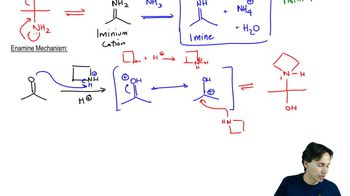
Enamine synthesis involves the formation of an enamine from a carbonyl compound and a secondary amine, such as pyrrolidine. The enamine acts as a nucleophile, allowing for subsequent alkylation reactions. This method is particularly useful for introducing new carbon chains to carbonyl compounds, facilitating the construction of more complex molecules.
Recommended video:
Guided course
06:25
Enamine Mechanism

Alkylation of Enamines

Alkylation of enamines occurs when the enamine nucleophile attacks an electrophile, typically an alkyl halide, leading to the formation of a new carbon-carbon bond. This reaction is regioselective and can be controlled by the choice of electrophile, allowing for the introduction of specific substituents at desired positions in the molecule.
Recommended video:
Guided course
06:25
Enamine Mechanism

Carbonyl Group Reactivity

Carbonyl groups are highly reactive functional groups due to the polarization of the carbon-oxygen double bond. In the context of the conversion from acetophenone to a product with two carbonyl groups, the reactivity of the carbonyl allows for nucleophilic attacks and further transformations, such as the formation of additional carbonyls through enamine intermediates.
Recommended video:
Guided course
03:50
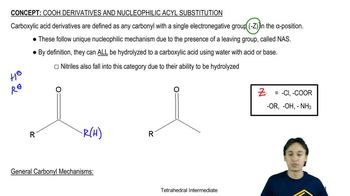
Intro to Carboxylic Acid Derivatives