Ch. 22 - Condensations and Alpha Substitutions of Carbonyl Compounds
Wade - Organic Chemistry 9th Edition
Wade9th EditionOrganic ChemistryISBN: 9780135213728Not the one you use?Change textbook
Chapter 22, Problem 56b

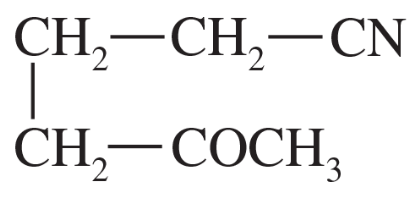
Show how the following products might be synthesized from suitable Michael donors and acceptors.
(b)

Verified step by step guidance
1
Step 1: Identify the product structure and recognize the functional groups. The product contains a cyclic ketone, a nitro group (-NO2), and a β-diketone structure. This suggests that the synthesis involves a Michael addition reaction.
Step 2: Determine the Michael donor. A β-diketone, such as acetylacetone (CH3COCH2COCH3), is a suitable Michael donor because it has acidic α-hydrogens that can be deprotonated to form an enolate ion.
Step 3: Determine the Michael acceptor. A nitroalkene, such as nitroethylene (CH2=CHNO2), is a suitable Michael acceptor because the electron-withdrawing nitro group stabilizes the negative charge formed during the addition.
Step 4: Outline the reaction mechanism. The enolate ion formed from the β-diketone attacks the β-carbon of the nitroalkene in a conjugate addition reaction. This forms a new C-C bond between the donor and acceptor.
Step 5: Cyclization and final product formation. After the Michael addition, intramolecular cyclization occurs, forming the cyclic ketone structure. Protonation and tautomerization complete the synthesis of the final product.

Verified video answer for a similar problem:

This video solution was recommended by our tutors as helpful for the problem above.
Video duration:
10m
Was this helpful?

Key Concepts

Here are the essential concepts you must grasp in order to answer the question correctly.

Michael Addition

Michael addition is a nucleophilic addition reaction where a nucleophile adds to an α,β-unsaturated carbonyl compound. In this reaction, a Michael donor, typically a compound with a nucleophilic site, attacks the electrophilic β-carbon of the unsaturated carbonyl, forming a new carbon-carbon bond. This reaction is crucial in organic synthesis for constructing complex molecules and is often used in the formation of various natural products.
Recommended video:
Guided course
09:23
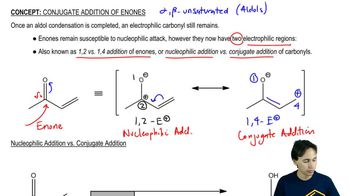
1,2 vs 1,4 Addition

Michael Donors and Acceptors

Michael donors are compounds that possess nucleophilic sites, such as enolates or other electron-rich species, which can donate electrons during the Michael addition. Michael acceptors, on the other hand, are typically α,β-unsaturated carbonyl compounds that can accept the nucleophilic attack due to the presence of a polarized double bond. Understanding the nature of these donors and acceptors is essential for predicting the outcome of the reaction and for designing synthetic pathways.
Recommended video:
Guided course
02:34
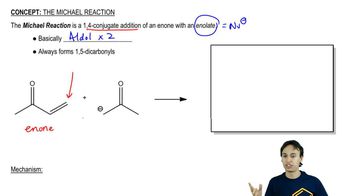
General Reaction

Synthesis Strategies in Organic Chemistry

Synthesis strategies in organic chemistry involve planning and executing a series of chemical reactions to construct a desired compound from simpler starting materials. This includes selecting appropriate reagents, reaction conditions, and understanding the mechanisms involved. In the context of the Michael addition, strategizing the choice of suitable Michael donors and acceptors is vital for achieving the target compound efficiently and selectively.
Recommended video:
Guided course
00:56
What is an organic molecule?