Ch. 22 - Condensations and Alpha Substitutions of Carbonyl Compounds
Wade - Organic Chemistry 9th Edition
Wade9th EditionOrganic ChemistryISBN: 9780135213728Not the one you use?Change textbook
Chapter 22, Problem 32a

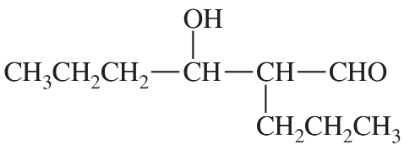
Show how each compound can be dissected into reagents joined by an aldol condensation, then decide whether the necessary aldol condensation is feasible.
(a)

Verified step by step guidance
1
Step 1: Analyze the given compound structure. The compound contains an aldehyde group (-CHO) and a hydroxyl group (-OH) on adjacent carbons, indicating it could be the product of an aldol condensation reaction.
Step 2: Recall the general mechanism of aldol condensation. It involves the reaction of two carbonyl compounds (aldehydes or ketones) in the presence of a base to form a β-hydroxy carbonyl compound. The β-hydroxy carbonyl compound can further undergo dehydration to form an α,β-unsaturated carbonyl compound.
Step 3: Identify the two carbonyl compounds that could combine to form the given compound. The aldehyde group (-CHO) and the hydroxyl group (-OH) suggest that one reagent must provide the aldehyde functionality, while the other reagent must provide the enolate ion that attacks the aldehyde.
Step 4: Dissect the compound into its possible precursors. The aldehyde group (-CHO) likely comes from a simple aldehyde, such as butanal (CH₃CH₂CH₂CHO). The enolate ion could be derived from a ketone, such as 2-ethylpentan-3-one (CH₃CH₂CH₂COCH₂CH₂CH₃), which forms the enolate at the α-carbon adjacent to the carbonyl group.
Step 5: Evaluate the feasibility of the aldol condensation. The reaction is feasible because both precursors (butanal and 2-ethylpentan-3-one) can form stable intermediates under basic conditions. The enolate ion from the ketone can attack the aldehyde to form the β-hydroxy carbonyl compound, which matches the structure of the given compound.

Verified video answer for a similar problem:

This video solution was recommended by our tutors as helpful for the problem above.
Video duration:
1m
Was this helpful?

Key Concepts

Here are the essential concepts you must grasp in order to answer the question correctly.

Aldol Condensation

Aldol condensation is a reaction between aldehydes or ketones that contain alpha-hydrogens, leading to the formation of β-hydroxy aldehydes or ketones. This reaction involves the nucleophilic addition of an enolate ion to a carbonyl compound, followed by dehydration to yield an α,β-unsaturated carbonyl compound. Understanding this process is crucial for dissecting compounds into their respective reagents.
Recommended video:
Guided course
09:51
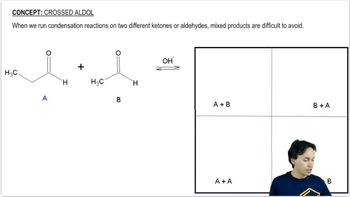
Crossed Aldol

Enolate Ion Formation

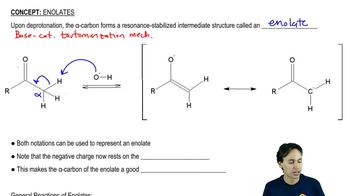
Enolate ions are formed when a base abstracts an alpha-hydrogen from a carbonyl compound, resulting in a resonance-stabilized anion. This ion acts as a nucleophile in aldol reactions, allowing it to attack another carbonyl carbon. Recognizing how to generate enolate ions from the given compounds is essential for determining the feasibility of the aldol condensation.
Recommended video:
Guided course
02:26
Formation of Enolates

Feasibility of Aldol Condensation

The feasibility of an aldol condensation depends on the structural features of the reactants, such as the presence of alpha-hydrogens and the stability of the resulting products. Factors like steric hindrance and the ability to form stable enolate ions influence whether the reaction will proceed. Evaluating these aspects is necessary to conclude if the aldol condensation can occur for the given compounds.
Recommended video:
Guided course
09:51
Crossed Aldol