
In Solved Problem 22-9, the target molecule was synthesized using a Michael addition to form the bond that is β,γ to the upper carbonyl group. Another approach is to use a Michael addition to form the bond that is β,γ to the other (lower) carbonyl group. Show how you would accomplish this alternative synthesis.
Ch. 22 - Condensations and Alpha Substitutions of Carbonyl Compounds
All textbooks
Wade 9th Edition
Ch. 22 - Condensations and Alpha Substitutions of Carbonyl Compounds
Problem 53
Wade 9th Edition
Ch. 22 - Condensations and Alpha Substitutions of Carbonyl Compounds
Problem 53Chapter 22, Problem 53
Show how cyclohexanone might be converted to the following δ-diketone (Hint: Stork).
Verified step by step guidance1
Identify the target molecule (δ-diketone) and recognize that the transformation involves the introduction of a second ketone group at the δ-position relative to the existing ketone in cyclohexanone. This suggests the use of a method that allows for selective functionalization at the δ-position.
Recall the Stork enamine reaction, which is a useful method for functionalizing ketones. Cyclohexanone can react with a secondary amine (e.g., pyrrolidine) to form an enamine intermediate. This enamine is nucleophilic and can undergo alkylation or acylation reactions.
React cyclohexanone with a secondary amine (e.g., pyrrolidine) and a catalytic amount of acid to form the enamine intermediate. The enamine will have a nucleophilic carbon at the α-position of the original ketone.
Perform an acylation reaction on the enamine using an acyl chloride (e.g., an appropriate acid chloride) to introduce the second ketone group at the δ-position. The enamine acts as a nucleophile, attacking the electrophilic carbonyl carbon of the acyl chloride.
Hydrolyze the resulting intermediate under acidic conditions to regenerate the ketone functionality and obtain the δ-diketone product. This step involves breaking the enamine back into the original ketone structure with the newly introduced ketone group at the δ-position.

Verified video answer for a similar problem:
This video solution was recommended by our tutors as helpful for the problem above.
Was this helpful?
Key Concepts
Here are the essential concepts you must grasp in order to answer the question correctly.
Cyclohexanone
Cyclohexanone is a cyclic ketone with the formula C6H10O, characterized by a six-membered carbon ring with a carbonyl group (C=O). It serves as a versatile intermediate in organic synthesis, often undergoing various reactions such as nucleophilic addition and oxidation. Understanding its reactivity is crucial for planning synthetic pathways, including transformations to more complex structures like δ-diketones.
Recommended video:
Guided course
Is the following disubstituted cyclohexane chiral?
Stork Enamine Reaction
The Stork enamine reaction is a method for synthesizing β-dicarbonyl compounds, where an enamine derived from a ketone reacts with an electrophile. This reaction allows for the introduction of new carbon chains at the β-position relative to the carbonyl group, facilitating the formation of δ-diketones. Familiarity with this reaction is essential for converting cyclohexanone into the desired product.
Recommended video:
Guided course
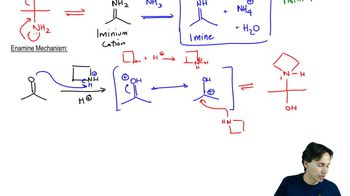
Enamine Mechanism
Diketones
Diketones are organic compounds containing two carbonyl groups (C=O) within the same molecule, typically positioned at different locations. They are important in various chemical reactions and can serve as key intermediates in organic synthesis. Understanding the structure and reactivity of diketones is vital for predicting the outcomes of reactions involving cyclohexanone and for designing synthetic routes to achieve specific diketone products.
Recommended video:
Guided course
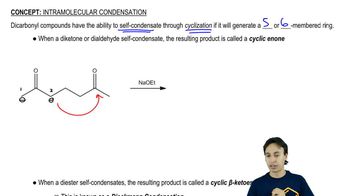
Diketones
Related Practice
Textbook Question
2
views
Textbook Question
Show the ketones that would result from hydrolysis and decarboxylation of the following β-keto esters.
1
views
Textbook Question
Show how an acetoacetic ester synthesis might be used to form a δ-diketone such as heptane-2,6-dione.
2
views
Textbook Question
Show how the following ketones might be synthesized by using the acetoacetic ester synthesis.
1
views
Textbook Question
Propose a mechanism for the conjugate addition of a nucleophile (Nuc:–) to acrylonitrile (H2C=CHCN) and to nitroethylene. Use resonance forms to show how the cyano and nitro groups activate the double bond toward conjugate addition.
2
views
Textbook Question
Propose a mechanism for the conjugate addition of a nucleophile (Nuc:–) to acrylonitrile (H2C=CHCN). Use resonance forms to show how the cyano activate the double bond toward conjugate addition.
1
views