Ch. 22 - Condensations and Alpha Substitutions of Carbonyl Compounds
Wade - Organic Chemistry 9th Edition
Wade9th EditionOrganic ChemistryISBN: 9780135213728Not the one you use?Change textbook
Chapter 22, Problem 43a

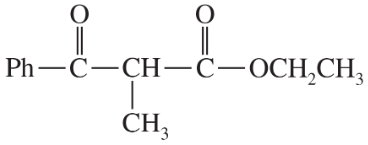
Show how crossed Claisen condensations could be used to prepare the following esters.
(a)

Verified step by step guidance
1
Step 1: Identify the ester product and determine the two components required for the crossed Claisen condensation. The product shown contains a phenyl group (Ph) attached to a ketone and an ethyl ester group. This suggests that one reactant should be a phenyl ketone (benzophenone derivative) and the other an ethyl ester.
Step 2: Recall the mechanism of a crossed Claisen condensation. This reaction involves the nucleophilic attack of an enolate ion (formed from one reactant) on the carbonyl carbon of the other reactant. Ensure that one reactant has no alpha hydrogens to prevent self-condensation.
Step 3: Choose the appropriate reactants. For this ester, the phenyl ketone (PhCOCH(CH3)) will act as the enolate donor, and ethyl acetate (CH3COOCH2CH3) will act as the electrophile. Ethyl acetate has alpha hydrogens and can form an enolate under basic conditions.
Step 4: Outline the reaction conditions. Use a strong base, such as sodium ethoxide (NaOEt), to generate the enolate from the phenyl ketone. The enolate will then attack the carbonyl carbon of ethyl acetate, forming a new C-C bond.
Step 5: After the condensation reaction, perform an acidic workup to neutralize the reaction mixture and isolate the desired ester product. This step ensures the product is stable and free from residual base.

Verified video answer for a similar problem:

This video solution was recommended by our tutors as helpful for the problem above.
Video duration:
1m
Was this helpful?

Key Concepts

Here are the essential concepts you must grasp in order to answer the question correctly.

Claisen Condensation

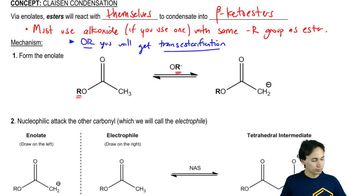
Claisen condensation is a reaction between two esters or an ester and a carbonyl compound in the presence of a strong base, leading to the formation of a β-keto ester or a β-diketone. This reaction involves the nucleophilic attack of an enolate ion on the carbonyl carbon of another ester, followed by the elimination of an alcohol. Understanding this mechanism is crucial for predicting the products of crossed Claisen condensations.
Recommended video:
Guided course
08:28
Claisen Condensation

Crossed Claisen Condensation

Crossed Claisen condensation refers to a variation of the Claisen reaction where two different esters or an ester and a carbonyl compound react. This approach allows for the synthesis of more complex molecules by selectively forming enolate ions from one ester while avoiding self-condensation. Mastery of this concept is essential for designing synthetic pathways to specific esters, as illustrated in the question.
Recommended video:
Guided course
08:28
Claisen Condensation

Enolate Ion Formation

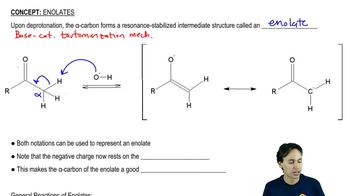
Enolate ions are reactive intermediates formed when a base abstracts a proton from the α-carbon of a carbonyl compound, resulting in a resonance-stabilized anion. The ability to generate enolate ions is fundamental in Claisen condensations, as they act as nucleophiles in the reaction. Recognizing how to form and utilize enolate ions is key to successfully executing crossed Claisen condensations and achieving desired ester products.
Recommended video:
Guided course
02:26
Formation of Enolates