Ch. 22 - Condensations and Alpha Substitutions of Carbonyl Compounds
Wade - Organic Chemistry 9th Edition
Wade9th EditionOrganic ChemistryISBN: 9780135213728Not the one you use?Change textbook
Chapter 22, Problem 39b

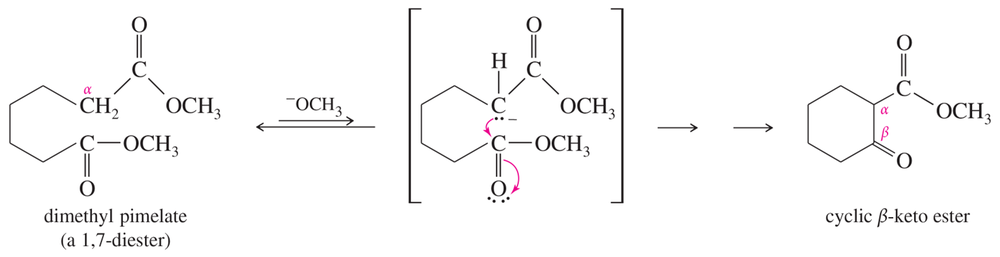
Propose mechanisms for the two Dieckmann condensations just shown.

Verified step by step guidance
1
Step 1: Identify the starting materials for the Dieckmann condensation. In the first reaction, the starting material is diethyl adipate (a 1,6-diesters), and in the second reaction, the starting material is dimethyl pimelate (a 1,7-diesters). Both are diesters capable of undergoing intramolecular condensation.
Step 2: Recognize the role of the base. The base used in the reaction is ethoxide ion (\( \text{CH}_3\text{CH}_2\text{O}^- \)). This base abstracts a proton from the alpha-carbon (\( \alpha \)) of one ester group, generating an enolate ion.
Step 3: Understand the nucleophilic attack. The enolate ion formed in Step 2 acts as a nucleophile and attacks the carbonyl carbon of the second ester group within the same molecule. This intramolecular reaction forms a cyclic intermediate.
Step 4: Analyze the intermediate. The cyclic intermediate undergoes elimination of the ethoxide group (\( \text{CH}_3\text{CH}_2\text{O}^- \)), resulting in the formation of a cyclic \( \beta \)-keto ester. For diethyl adipate, a five-membered ring is formed, while for dimethyl pimelate, a six-membered ring is formed.
Step 5: Confirm the product. The final products are cyclic \( \beta \)-keto esters. For diethyl adipate, the product is a five-membered cyclic \( \beta \)-keto ester, and for dimethyl pimelate, the product is a six-membered cyclic \( \beta \)-keto ester. These products are stabilized by resonance between the keto and ester groups.

Verified video answer for a similar problem:

This video solution was recommended by our tutors as helpful for the problem above.
Video duration:
7m
Was this helpful?

Key Concepts

Here are the essential concepts you must grasp in order to answer the question correctly.

Dieckmann Condensation

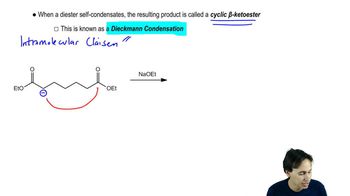
The Dieckmann condensation is a reaction involving the intramolecular condensation of diesters to form cyclic β-keto esters. This reaction typically occurs under basic conditions, where a base deprotonates an α-hydrogen, allowing the resulting enolate to attack the carbonyl carbon of another ester group. The process results in the formation of a five- or six-membered ring, depending on the distance between the ester groups.
Recommended video:
Guided course
03:27
Diesters (Dieckmann Condensation)

Enolate Formation

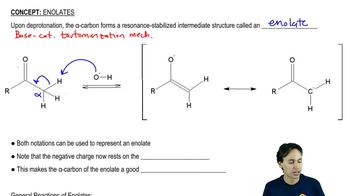
Enolate formation is a crucial step in many carbonyl chemistry reactions, including the Dieckmann condensation. In this process, a base abstracts an α-hydrogen from a carbonyl compound, generating a resonance-stabilized enolate ion. This enolate can then act as a nucleophile, attacking electrophilic centers, such as carbonyl carbons, facilitating the formation of new carbon-carbon bonds.
Recommended video:
Guided course
02:26
Formation of Enolates

Cyclic β-Keto Esters

Cyclic β-keto esters are compounds formed from the Dieckmann condensation, characterized by a cyclic structure containing both a ketone and an ester functional group. These compounds are significant in organic synthesis due to their reactivity and ability to undergo further transformations. The presence of both functional groups allows for diverse chemical reactivity, making them valuable intermediates in the synthesis of various organic molecules.
Recommended video:
Guided course
02:39
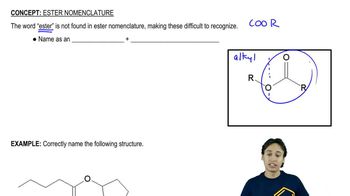
Ester Nomenclature