Ch. 22 - Condensations and Alpha Substitutions of Carbonyl Compounds
Wade - Organic Chemistry 9th Edition
Wade9th EditionOrganic ChemistryISBN: 9780135213728Not the one you use?Change textbook
Chapter 22, Problem 62a

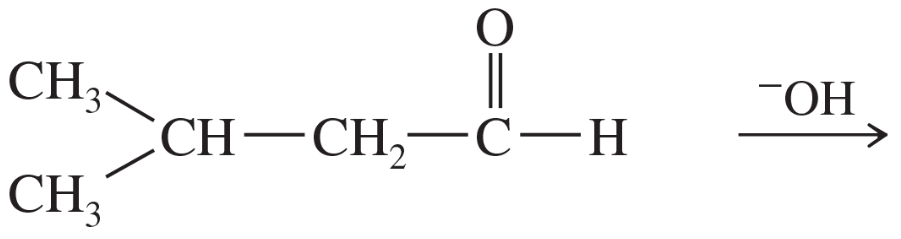
Predict the products of the following aldol condensations. Show the products both before and after dehydration.
(a)

Verified step by step guidance
1
Step 1: Identify the reactants and the type of reaction. The given reaction involves an aldol condensation, which typically occurs between an aldehyde or ketone with an α-hydrogen in the presence of a base (here, -OH). The reactant is isobutyraldehyde (CH3)2CHCH2CHO.
Step 2: Determine the enolate formation. In the presence of a base, the α-hydrogen (hydrogen attached to the carbon adjacent to the carbonyl group) is abstracted, forming an enolate ion. The enolate ion is resonance-stabilized, with the negative charge delocalized between the α-carbon and the oxygen of the carbonyl group.
Step 3: Perform the nucleophilic attack. The enolate ion acts as a nucleophile and attacks the carbonyl carbon of another molecule of isobutyraldehyde. This forms a β-hydroxyaldehyde intermediate, which is the product before dehydration.
Step 4: Dehydration step. Under the reaction conditions, the β-hydroxyaldehyde undergoes dehydration (loss of water) to form an α,β-unsaturated aldehyde. This step involves the elimination of a hydroxyl group (-OH) and a hydrogen atom from the β-carbon and α-carbon, respectively, resulting in the formation of a double bond between the α- and β-carbons.
Step 5: Write the final products. The product before dehydration is the β-hydroxyaldehyde, and the product after dehydration is the α,β-unsaturated aldehyde. Ensure the chemical structures are drawn correctly to reflect these transformations.

Verified video answer for a similar problem:

This video solution was recommended by our tutors as helpful for the problem above.
Video duration:
7m
Was this helpful?

Key Concepts

Here are the essential concepts you must grasp in order to answer the question correctly.

Aldol Condensation

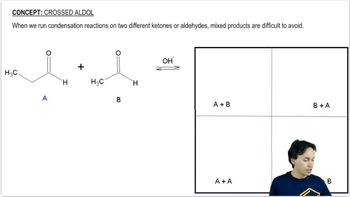
Aldol condensation is a reaction between aldehydes or ketones that contain alpha-hydrogens, leading to the formation of β-hydroxy aldehydes or ketones. This reaction involves the nucleophilic addition of an enolate ion to a carbonyl compound, followed by dehydration to yield an α,β-unsaturated carbonyl compound. Understanding this process is crucial for predicting the products of the reaction.
Recommended video:
Guided course
09:51
Crossed Aldol

Enolate Ion Formation

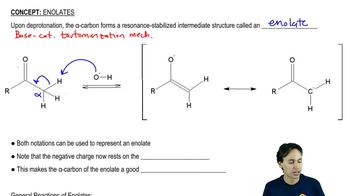
Enolate ions are formed when a base abstracts an alpha-hydrogen from a carbonyl compound, resulting in a resonance-stabilized anion. This ion acts as a nucleophile in aldol reactions, attacking the carbonyl carbon of another molecule. Recognizing how enolate ions are generated and their role in the reaction mechanism is essential for predicting the products of aldol condensations.
Recommended video:
Guided course
02:26
Formation of Enolates

Dehydration Step

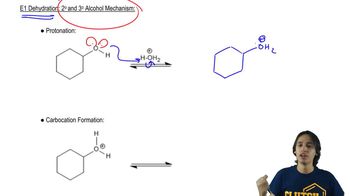
The dehydration step in aldol condensation involves the elimination of a water molecule from the β-hydroxy carbonyl compound, resulting in the formation of an α,β-unsaturated carbonyl compound. This step is driven by the stability of the resulting double bond and is crucial for completing the reaction. Understanding this step helps in identifying the final products of the aldol condensation process.
Recommended video:
Guided course
05:21
Dehydration of 2° and 3° alcohols:The E1 Mechanism.