Ch. 22 - Condensations and Alpha Substitutions of Carbonyl Compounds
Wade - Organic Chemistry 9th Edition
Wade9th EditionOrganic ChemistryISBN: 9780135213728Not the one you use?Change textbook
Chapter 22, Problem 81

(A true story.) Chemistry lab students added an excess of ethylmagnesium bromide to methyl furoate, expecting the Grignard reagent to add twice and form the tertiary alcohol. After water workup, they found that the product was a mixture of two compounds. One was the expected product having two ethyl groups, but the unexpected product had added three ethyl groups. Propose a mechanism to explain the formation of the unexpected product.

Verified step by step guidance
1
Step 1: Recognize that methyl furoate is an ester, which reacts with Grignard reagents to form alcohols. The Grignard reagent, ethylmagnesium bromide (CH₃CH₂MgBr), is nucleophilic and will attack the carbonyl carbon of the ester.
Step 2: In the first addition, the Grignard reagent attacks the carbonyl carbon of methyl furoate, breaking the C=O bond and forming a tetrahedral intermediate. The intermediate then collapses, expelling the methoxy group (-OCH₃) as a leaving group, resulting in a ketone intermediate.
Step 3: The ketone intermediate undergoes a second nucleophilic attack by another molecule of ethylmagnesium bromide. This forms a tertiary alcohol after the water workup, which is the expected product with two ethyl groups attached to the furan ring.
Step 4: To explain the unexpected product, consider that the furan ring is electron-rich and can act as a nucleophile. After the second addition, the furan ring may react with another molecule of ethylmagnesium bromide, leading to the addition of a third ethyl group at the 5-position of the furan ring.
Step 5: The final water workup protonates the oxygen atoms, stabilizing the products. This results in a mixture of the expected tertiary alcohol (with two ethyl groups) and the unexpected product (with three ethyl groups, including one attached to the furan ring).

Verified video answer for a similar problem:

This video solution was recommended by our tutors as helpful for the problem above.
Video duration:
5m
Was this helpful?

Key Concepts

Here are the essential concepts you must grasp in order to answer the question correctly.

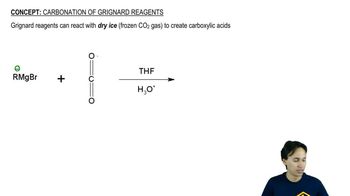
Grignard Reagents

Grignard reagents, such as ethylmagnesium bromide, are organomagnesium compounds that act as nucleophiles in organic reactions. They can react with carbonyl compounds to form alcohols. Understanding their reactivity is crucial for predicting the outcomes of reactions, especially when excess reagent is used, as it can lead to multiple addition reactions.
Recommended video:
Guided course
02:12
Carbonation of Grignard Reagents

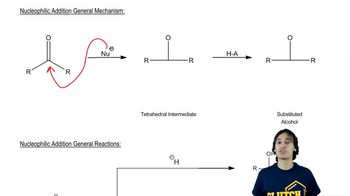
Nucleophilic Addition Mechanism

The nucleophilic addition mechanism involves the attack of a nucleophile, like a Grignard reagent, on an electrophilic carbon, such as that in a carbonyl group. This process can occur multiple times if there is an excess of the nucleophile, leading to the formation of products with varying degrees of substitution, which is key to explaining the unexpected product in this scenario.
Recommended video:
Guided course
08:27
Nucleophilic Addition

Water Workup

Water workup is a common procedure in organic synthesis that involves adding water to a reaction mixture to quench the reaction and extract organic products. In this case, it helps to hydrolyze any remaining Grignard reagent and convert the intermediate alkoxides into alcohols. Understanding this step is essential for analyzing the final product composition and the reaction's overall mechanism.
Recommended video:
1:35
Metal Ion Catalysis: Water Activation Concept 1