Ch. 21 - Carboxylic Acid Derivatives
Wade - Organic Chemistry 9th Edition
Wade9th EditionOrganic ChemistryISBN: 9780135213728Not the one you use?Change textbook
Chapter 21, Problem 8a,b

Show how you would synthesize the following esters from appropriate acyl chlorides and alcohols.
(a) ethyl propionate
(b) phenyl 3-methylhexanoate

Verified step by step guidance
1
Identify the ester structure and break it down into its two components: the alcohol and the acyl chloride. For an ester, the part attached to the oxygen (R-O) comes from the alcohol, and the part attached to the carbonyl group (R-C=O) comes from the acyl chloride.
For (a) ethyl propionate: The ester is composed of an ethyl group (from ethanol, CH₃CH₂OH) and a propionyl group (from propionyl chloride, CH₃CH₂COCl).
For (b) phenyl 3-methylhexanoate: The ester is composed of a phenyl group (from phenol, C₆H₅OH) and a 3-methylhexanoyl group (from 3-methylhexanoyl chloride, CH₃CH₂CH(CH₃)CH₂CH₂COCl).
Write the general reaction for esterification: An acyl chloride reacts with an alcohol to form an ester and HCl. The reaction can be represented as: R-C=O-Cl+R1OHR-C=O-OR1+HCl.
Combine the appropriate alcohol and acyl chloride for each ester: (a) React ethanol (CH₃CH₂OH) with propionyl chloride (CH₃CH₂COCl) to form ethyl propionate. (b) React phenol (C₆H₅OH) with 3-methylhexanoyl chloride (CH₃CH₂CH(CH₃)CH₂CH₂COCl) to form phenyl 3-methylhexanoate.

Verified video answer for a similar problem:

This video solution was recommended by our tutors as helpful for the problem above.
Video duration:
5m
Was this helpful?

Key Concepts

Here are the essential concepts you must grasp in order to answer the question correctly.

Esterification Reaction

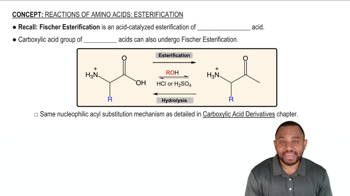
Esterification is a chemical reaction between an alcohol and a carboxylic acid (or acyl chloride) that produces an ester and water. In this process, the hydroxyl group of the acid reacts with the hydrogen of the alcohol, leading to the formation of an ester bond. Understanding this reaction is crucial for synthesizing esters, as it outlines the fundamental mechanism involved.
Recommended video:
1:21
Reactions of Amino Acids: Esterification Concept 1

Acyl Chlorides

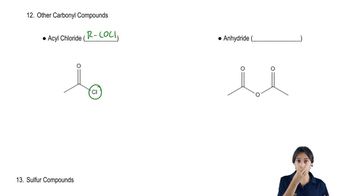
Acyl chlorides, also known as acid chlorides, are reactive derivatives of carboxylic acids where the hydroxyl group is replaced by a chlorine atom. They are highly reactive and can readily react with alcohols to form esters. Recognizing the role of acyl chlorides in ester synthesis is essential, as they provide a more efficient pathway compared to using carboxylic acids directly.
Recommended video:
Guided course
01:57
Recognizing acyl chlorides and anhydrides.

Alcohols in Ester Synthesis

Alcohols are organic compounds containing one or more hydroxyl (-OH) groups. In ester synthesis, the choice of alcohol affects the structure and properties of the resulting ester. For example, using ethanol will yield ethyl esters, while using phenol will yield phenyl esters. Understanding the specific alcohols needed for the desired esters is key to successful synthesis.
Recommended video:
01:28
Synthesis of Amino Acids: Acetamidomalonic Ester Synthesis Example 2