Ch. 21 - Carboxylic Acid Derivatives
Wade - Organic Chemistry 9th Edition
Wade9th EditionOrganic ChemistryISBN: 9780135213728Not the one you use?Change textbook
Chapter 21, Problem 38a

Show how you would convert the following starting materials to the indicated nitriles:
(a) phenylacetic acid → phenylacetonitrile

Verified step by step guidance
1
Identify the functional group in the starting material, phenylacetic acid. It contains a carboxylic acid group (-COOH) attached to a benzyl group (C6H5-CH2-). The goal is to replace the carboxylic acid group with a nitrile group (-CN).
Recall that carboxylic acids can be converted to nitriles through a two-step process: (1) conversion of the carboxylic acid to an amide intermediate, and (2) dehydration of the amide to form the nitrile.
In the first step, react phenylacetic acid with a reagent like thionyl chloride (SOCl2) to convert the carboxylic acid into an acid chloride (phenylacetyl chloride). This step activates the carboxylic acid for further reaction.
In the second step, react the acid chloride with ammonia (NH3) to form the corresponding amide, phenylacetamide. This occurs via nucleophilic substitution, where ammonia attacks the carbonyl carbon of the acid chloride.
Finally, dehydrate the amide using a dehydrating agent such as phosphorus pentoxide (P2O5) or thionyl chloride (SOCl2) to form phenylacetonitrile. This step removes water from the amide, resulting in the nitrile group (-CN).

Verified video answer for a similar problem:

This video solution was recommended by our tutors as helpful for the problem above.
Video duration:
3m
Was this helpful?

Key Concepts

Here are the essential concepts you must grasp in order to answer the question correctly.

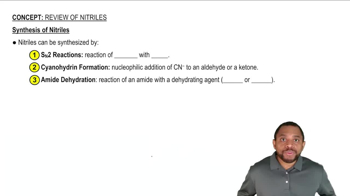
Nitrile Synthesis

Nitriles are organic compounds containing a cyano group (-C≡N). One common method to synthesize nitriles is through the conversion of carboxylic acids or their derivatives. In this case, phenylacetic acid can be converted to phenylacetonitrile via a dehydration reaction, often using reagents like thionyl chloride or phosphorus pentoxide to facilitate the transformation.
Recommended video:
0:59
Review of Nitriles Concept 1

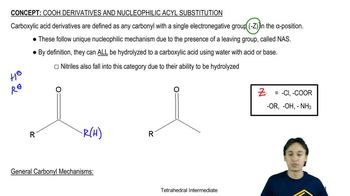
Carboxylic Acid Derivatives

Carboxylic acids can be transformed into various derivatives, such as acid chlorides, esters, and amides, which can further react to form nitriles. Understanding these derivatives is crucial for predicting reaction pathways. For phenylacetic acid, converting it to an acid chloride is a key step before further reaction to yield the desired nitrile.
Recommended video:
Guided course
03:50
Intro to Carboxylic Acid Derivatives

Reagents and Reaction Conditions

The choice of reagents and reaction conditions is vital in organic synthesis. For the conversion of phenylacetic acid to phenylacetonitrile, reagents like thionyl chloride (SOCl2) or phosphorus oxychloride (POCl3) are commonly used to create the acid chloride intermediate. The subsequent reaction with a suitable nucleophile, such as sodium cyanide, leads to the formation of the nitrile.
Recommended video: