Ch. 21 - Carboxylic Acid Derivatives
Wade - Organic Chemistry 9th Edition
Wade9th EditionOrganic ChemistryISBN: 9780135213728Not the one you use?Change textbook
Chapter 21, Problem 48e,f

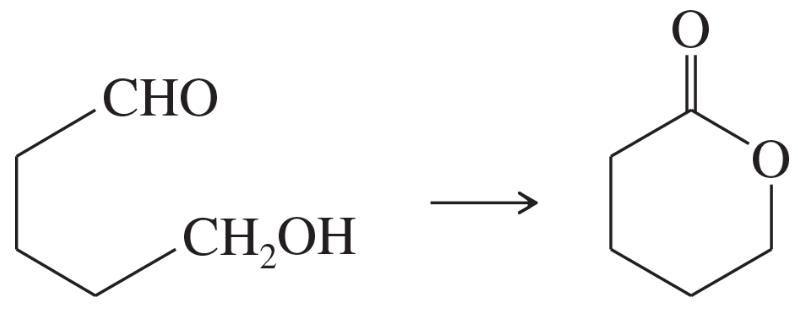
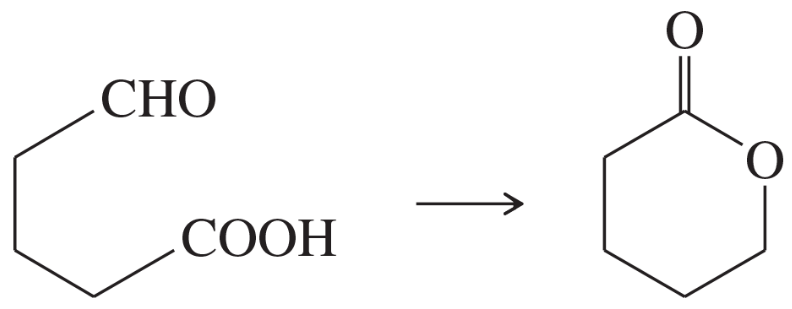
Show how you would accomplish the following syntheses in good yields.
(e)
(f)

Verified step by step guidance
1
Step 1: Analyze the starting materials and products for both reactions. In (i), the starting material is a molecule with an aldehyde (-CHO) and a primary alcohol (-CH2OH) group. The product is a cyclic ester (lactone). In (ii), the starting material has an aldehyde (-CHO) and a carboxylic acid (-COOH) group, and the product is also a cyclic ester (lactone).
Step 2: For reaction (i), recognize that the formation of a lactone involves intramolecular esterification. The primary alcohol (-CH2OH) reacts with the aldehyde (-CHO) after oxidation of the aldehyde to a carboxylic acid. Use an oxidizing agent such as PCC (Pyridinium Chlorochromate) or KMnO4 to convert the aldehyde to a carboxylic acid.
Step 3: After oxidation in (i), the molecule now contains a carboxylic acid (-COOH) and a primary alcohol (-CH2OH). Heat the compound to promote intramolecular esterification, where the alcohol attacks the carboxylic acid to form the cyclic ester (lactone).
Step 4: For reaction (ii), the starting material already contains both a carboxylic acid (-COOH) and an aldehyde (-CHO). First, oxidize the aldehyde to a carboxylic acid using an oxidizing agent such as PCC or KMnO4. This results in a molecule with two carboxylic acid groups.
Step 5: Heat the molecule from (ii) to promote intramolecular esterification. The carboxylic acid group reacts with the adjacent hydroxyl group to form the cyclic ester (lactone). Ensure the reaction conditions favor cyclization and avoid overreaction or polymerization.

Verified video answer for a similar problem:

This video solution was recommended by our tutors as helpful for the problem above.
Video duration:
2m
Was this helpful?

Key Concepts

Here are the essential concepts you must grasp in order to answer the question correctly.

Lactone Formation

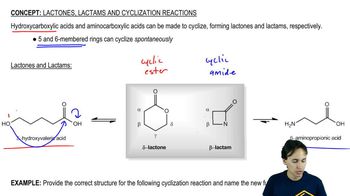
Lactones are cyclic esters formed from the intramolecular reaction of a hydroxy acid. In the synthesis of lactones, a hydroxyl group reacts with a carbonyl group, leading to the formation of a ring structure. This process often requires acid or heat to facilitate the reaction and can yield good results when the reactants are positioned favorably.
Recommended video:
Guided course
05:19
Lactones and Lactams

Lactam Synthesis

Lactams are cyclic amides formed through the reaction of an amino group with a carbonyl group, typically in the presence of an acid catalyst. The formation of lactams involves the nucleophilic attack of the amine on the carbonyl carbon, followed by the elimination of water to create a stable ring structure. Understanding the reactivity of amines and carbonyls is crucial for successful lactam synthesis.
Recommended video:
Guided course
05:19
Lactones and Lactams

Synthesis Strategies

Effective synthesis strategies in organic chemistry involve selecting appropriate starting materials and reaction conditions to maximize yield. This includes considering factors such as sterics, electronics, and the stability of intermediates. Knowledge of reaction mechanisms and the ability to predict product formation are essential for designing efficient synthetic pathways.
Recommended video:
1:16
Synthesis of Amino Acids: Strecker Synthesis Example 1