Ch. 21 - Carboxylic Acid Derivatives
Wade - Organic Chemistry 9th Edition
Wade9th EditionOrganic ChemistryISBN: 9780135213728Not the one you use?Change textbook
Chapter 21, Problem 49d

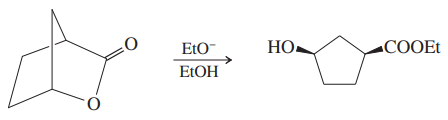
Propose mechanisms for the following reactions.
(d) Chemical reaction diagram showing ester hydrolysis with reactants and products labeled.

Verified step by step guidance
1
Identify the starting material as a bicyclic anhydride and the product as a lactone with an ester group. The reaction involves a ring-opening and formation of a new ring.
Recognize that the ethoxide ion (EtO-) acts as a nucleophile, which will attack the carbonyl carbon of the anhydride, leading to the opening of the anhydride ring.
After the nucleophilic attack, the intermediate formed will have a carboxylate group and an alkoxide group. The alkoxide can then undergo intramolecular nucleophilic attack on the other carbonyl group, leading to the formation of a new ring.
The intramolecular attack results in the formation of a five-membered lactone ring, with the carboxylate group being converted into an ester group through the reaction with ethanol (EtOH).
Finally, the stereochemistry of the product is determined by the configuration of the starting material and the mechanism of the reaction, resulting in the observed stereochemistry of the hydroxyl and ester groups in the product.

Verified video answer for a similar problem:

This video solution was recommended by our tutors as helpful for the problem above.
Video duration:
3m
Was this helpful?

Key Concepts

Here are the essential concepts you must grasp in order to answer the question correctly.

Ester Hydrolysis

Ester hydrolysis is a chemical reaction where an ester is converted into an alcohol and a carboxylic acid or its salt. This process can occur under acidic or basic conditions. In basic hydrolysis, also known as saponification, the ester reacts with a base, such as sodium hydroxide, to form an alcohol and a carboxylate salt.
Recommended video:
0:48
Hydrolysis of Phosphate Esters Concept 2

Nucleophilic Acyl Substitution

Nucleophilic acyl substitution is a fundamental reaction mechanism in organic chemistry where a nucleophile attacks the carbonyl carbon of an acyl compound, leading to the substitution of the leaving group. This mechanism is crucial in the transformation of esters into other functional groups, such as alcohols and carboxylic acids, especially under basic conditions.
Recommended video:
Guided course
01:47
Nucleophiles and Electrophiles can react in Substitution Reactions.

Base-Catalyzed Reaction

In a base-catalyzed reaction, a base facilitates the reaction by deprotonating a reactant, increasing its nucleophilicity. In the context of ester hydrolysis, the base (EtO-) deprotonates the alcohol, enhancing its ability to attack the ester carbonyl carbon, leading to the formation of the hydrolysis products. This mechanism is essential for understanding the role of bases in organic transformations.
Recommended video:
Guided course
01:57
Base Catalyzed