Ch. 21 - Carboxylic Acid Derivatives
Wade - Organic Chemistry 9th Edition
Wade9th EditionOrganic ChemistryISBN: 9780135213728Not the one you use?Change textbook
Chapter 21, Problem 50l

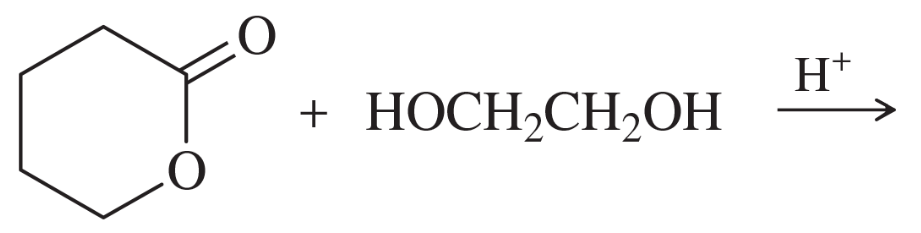
Predict the products of the following reactions.
(l)

Verified step by step guidance
1
Step 1: Identify the functional groups in the reactants. The cyclic compound contains a ketone and an ester functional group. The second reactant is ethylene glycol (HOCH₂CH₂OH), which is a diol (contains two hydroxyl groups). The reaction occurs under acidic conditions (H⁺).
Step 2: Recognize the type of reaction. This is an acetal formation reaction, where a ketone reacts with a diol under acidic conditions to form a cyclic acetal. Acetals are stable compounds often used to protect carbonyl groups in organic synthesis.
Step 3: Understand the mechanism. The reaction begins with protonation of the ketone oxygen by the acid catalyst, making the carbonyl carbon more electrophilic. The diol then attacks the carbonyl carbon, forming a tetrahedral intermediate.
Step 4: The intermediate undergoes proton transfer and elimination of water to form a hemiacetal. The second hydroxyl group of the diol then attacks the hemiacetal carbon, leading to the formation of a cyclic acetal after another elimination of water.
Step 5: Predict the product. The cyclic acetal formed will have the diol incorporated into the structure, with the two oxygen atoms of the diol forming a ring with the original carbonyl carbon. This protects the ketone group in the molecule.

Verified video answer for a similar problem:

This video solution was recommended by our tutors as helpful for the problem above.
Video duration:
2m
Was this helpful?

Key Concepts

Here are the essential concepts you must grasp in order to answer the question correctly.

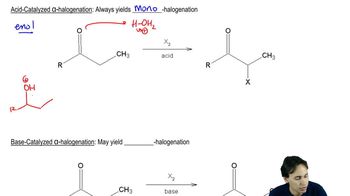
Acid-Catalyzed Reactions

Acid-catalyzed reactions involve the use of an acid to increase the rate of a chemical reaction. In organic chemistry, acids can protonate reactants, making them more electrophilic and facilitating nucleophilic attacks. This is particularly important in reactions involving alcohols and carbonyl compounds, where the acid can enhance the reactivity of the carbonyl carbon.
Recommended video:
Guided course
03:09
Acid Catalyzed

Nucleophilic Addition

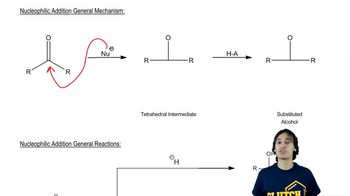
Nucleophilic addition is a fundamental reaction mechanism in organic chemistry where a nucleophile attacks an electrophilic carbon atom, typically found in carbonyl groups. In this case, the alcohol acts as a nucleophile, attacking the electrophilic carbon of the cyclic compound's carbonyl, leading to the formation of a new bond and the potential for product formation.
Recommended video:
Guided course
08:27
Nucleophilic Addition

Cyclic Compounds and Ring Strain

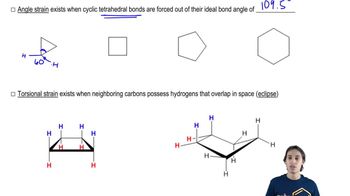
Cyclic compounds are molecules that contain a ring structure, which can introduce ring strain depending on the size and substituents of the ring. In the context of the reaction, the cyclic compound may have specific steric and electronic properties that influence its reactivity with the alcohol. Understanding the stability and strain of the ring is crucial for predicting the outcome of the reaction.
Recommended video:
Guided course
02:46
What is angle strain?