Ch. 21 - Carboxylic Acid Derivatives
Wade - Organic Chemistry 9th Edition
Wade9th EditionOrganic ChemistryISBN: 9780135213728Not the one you use?Change textbook
Chapter 21, Problem 59b

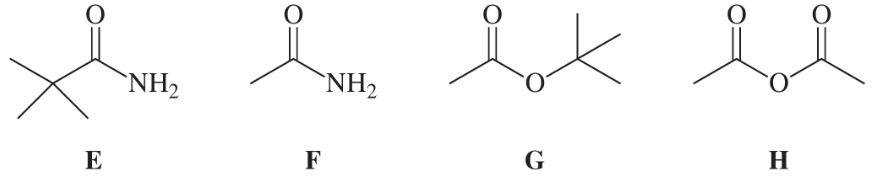
In each part, rank the compounds in order of increasing rate of nucleophilic attack at C=O by a strong nucleophile like methoxide.
(b)

Verified step by step guidance
1
Step 1: Identify the functional groups attached to the carbonyl (C=O) in each compound. Compound E and F are amides (R-C=O-NH2), compound G is an ester (R-C=O-O-R'), and compound H is an anhydride (R-C=O-O-C=O-R').
Step 2: Understand the electronic effects of the functional groups. Amides (E and F) have resonance stabilization due to the lone pair on nitrogen, which reduces the electrophilicity of the carbonyl carbon. Esters (G) have less resonance stabilization compared to amides, making the carbonyl carbon more electrophilic. Anhydrides (H) are highly reactive due to the presence of two carbonyl groups, which increase the electrophilicity of the carbonyl carbon.
Step 3: Consider steric hindrance. Compound E has bulky alkyl groups near the carbonyl carbon, which can hinder nucleophilic attack. Compound F has less steric hindrance compared to E. Compound G has moderate steric hindrance due to the alkyl group attached to the oxygen. Compound H has minimal steric hindrance.
Step 4: Rank the compounds based on the combined effects of resonance stabilization, steric hindrance, and electrophilicity. Amides (E and F) will have the slowest rate of nucleophilic attack due to resonance stabilization, with E being slower than F due to steric hindrance. Esters (G) will have a faster rate than amides due to reduced resonance stabilization. Anhydrides (H) will have the fastest rate due to high electrophilicity and minimal steric hindrance.
Step 5: Final ranking in order of increasing rate of nucleophilic attack: E < F < G < H.

Verified video answer for a similar problem:

This video solution was recommended by our tutors as helpful for the problem above.
Video duration:
4m
Was this helpful?

Key Concepts

Here are the essential concepts you must grasp in order to answer the question correctly.

Nucleophilicity

Nucleophilicity refers to the ability of a nucleophile to donate an electron pair to an electrophile, such as a carbonyl carbon in a C=O bond. Strong nucleophiles, like methoxide, are more reactive and can effectively attack electrophilic centers. The strength of a nucleophile is influenced by factors such as charge, electronegativity, and steric hindrance.
Recommended video:
Guided course
08:27
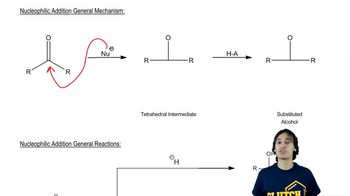
Nucleophilic Addition

Electrophilicity of Carbonyl Compounds

The electrophilicity of carbonyl compounds is determined by the nature of the substituents attached to the carbonyl carbon. Electron-withdrawing groups increase the positive character of the carbonyl carbon, making it more susceptible to nucleophilic attack. Conversely, electron-donating groups can decrease electrophilicity, affecting the rate of reaction with nucleophiles.
Recommended video:
Guided course
01:40
Defining meso compounds.

Steric Hindrance

Steric hindrance refers to the repulsion between atoms that occurs when they are brought close together, which can impede reactions. In the context of nucleophilic attack on carbonyl compounds, bulky substituents around the carbonyl can hinder the approach of nucleophiles, thus affecting the reaction rate. Understanding steric effects is crucial for predicting the reactivity of different carboxylic acid derivatives.
Recommended video:
Guided course
02:53
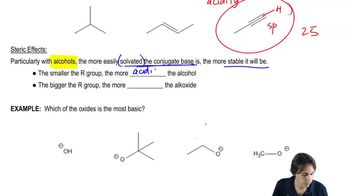
Understanding steric effects.
Related Practice
Textbook Question

In each part, rank the compounds in order of increasing rate of nucleophilic attack at C=O by a strong nucleophile like methoxide.

(a)

1
views

Textbook Question

Methyl p-nitrobenzoate has been found to undergo saponification faster than methyl benzoate.

(b) Would you expect methyl p-methoxybenzoate to undergo saponification faster or slower than methyl benzoate?

1
views
Textbook Question

The structures of four useful polymers are shown, together with some of their best-known products. In each case,

(i) Determine the kind of polymer (polyamide, polyester, etc.).

(ii) Draw the structures of the monomers that would be released by complete hydrolysis.

(iii) Suggest what monomers or stable derivatives of the monomers might be used to make these polymers.

(a)

6
views
Textbook Question

Methyl p-nitrobenzoate has been found to undergo saponification faster than methyl benzoate.

(a) Consider the mechanism of saponification, and explain the reasons for this rate enhancement.

Textbook Question

In Section 21-16, we saw that Sevin insecticide is made by the reaction of 1-naphthol with methyl isocyanate. A Union Carbide plant in Bhopal, India, once used this process to make Sevin for use as an agricultural insecticide. On December 3,1984, either by accident or by sabotage, a valve was opened that admitted water to a large tank of methyl isocyanate. The pressure and temperature within the tank rose dramatically, and pressure-relief valves opened to keep the tank from bursting. A large quantity of methyl isocyanate rushed out through the pressure-relief valves, and the vapors flowed with the breeze into populated areas, killing about 2500 people and injuring many more.

(a) Write an equation for the reaction that took place in the tank. Explain why the pressure and temperature rose dramatically.

(b) Propose a mechanism for the reaction you wrote in part (a).

8
views
Textbook Question

Explain this curious result. What does this reaction tell you about the relative reactivity of esters and ketones?

6
views